https://www.rizospastis.gr/story.do?id=13338924
SECTORAL ORGANIZATIONS OF THE KKE AND KNE IN PIRAEUS AND BRANCHES OF THE PEAEA AND DSE
Honor to the unyielding fighters of the class struggle and a militant message against the plans to distort historical memory
Major event at the premises of the former Aegina Prison
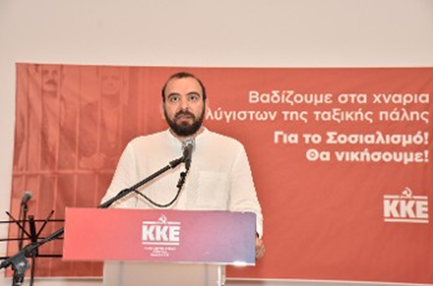
With a great event on Sunday morning at the historic Aegina Prison building, the Piraeus Regional Organizations of the KKE and KNE, along with the Piraeus branches of the Panhellenic Union of National Resistance Fighters and Democratic Army of Greece paid tribute to the communists and other activists who were imprisoned, tortured, and executed in yet another labor camp of the bourgeois state, yet remained unyielding, drawing strength from their faith in the justice of the people and in socialism-communism
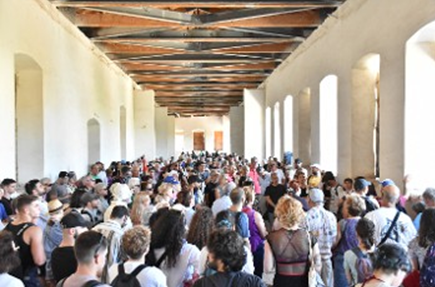
At the same time, the mass rally—which drew a large crowd of people of all ages, including many Aegina residents—sent a strong message of opposition to plans to distort historical memory.
Specifically, it was a response to the unacceptable decision by the government and the Attica Regional Authority to grant part of the historic building of the former Aegina Prison to an NGO for the creation of a “Pistachio Museum.”
“The Aegina Prison is not for sale, not for rent, and not for acquisition. Defending the history of our people and of Aegina is a matter for all of us,” read the banner at the head of the militant march from the port to the prison grounds.
There, with great interest, the participants took part in a guided tour on the history of the first building of the modern Greek state, whose construction began in 1828, and, of course, on the heroic chapters written there by the political prisoners who were incarcerated there . The tour was led by Antonia Dimitroulakou, Secretary of the Aegina Local Committee of the Communist Party of Greece (KKE), and Zoe Georgiadou, professor of architecture at the University of West Attica.
A particularly memorable moment came when Ms. Flora Alyfanti took the floor, sharing her childhood memories as a longtime resident of the area. Such as when the prisoners would lower Karagiozis puppets—which they had made themselves—from the windows on strings and give them to the children. Or when they informed the island’s people: “People of Aegina, they are taking us to be executed.”
This was followed by the main event, featuring Nikos Abatielos, a member of the Political Bureau of the Central Committee of the Communist Party of Greece (KKE) and the Party’s Member of Parliament for the First District of Piraeus, as the keynote speaker.
Nikos Fassas, a member of the Central Committee of the KNE and Secretary of the Piraeus Regional Organization of the KNE, delivered a greeting, noting among other things: “We are here, as the Youth of the KKE, going against the tide and the system’s calls for submission, always in the name of ‘realism.’ Because the attempt to transform this sacred site into a mere building with a completely different character is neither innocent nor accidental; it has precisely this goal: to erase the generations who will learn, be taught, and be inspired by the greatest human ideals that have made our people giants in history!”
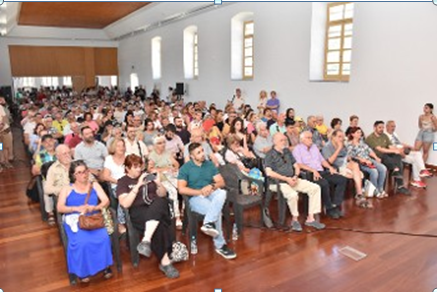
Nikos Triantafyllou, a member of the Board of Directors of the Union of the Imprisoned and Exiled, also addressed the event, making it clear that “we oppose any commercial activity at these historic monuments. We demand that the state take responsibility for their preservation and ensure the necessary conditions so that these sites are accessible to anyone who wishes to visit them, whether individually or, primarily, through organized visits with the mass organizations of the movement and the youth.”
The event concluded with a musical performance by Kostas Vlachoutsos, Leda Kalliopi Aggelou, and Periklis Malakates. Also in attendance were Diamanto Manolakou, KKE Member of Parliament for Piraeus B; Stelios Benetatos, Attica Regional Councilor with “Laiki Synepirosi”; Panagiotis Ilias, head of the “People’s Rally” in Aegina, and Stavros Tassos, president of EEDYE. Following the conclusion of the event, wreaths were laid.
N. Abatielos and D. Manolakou laid a wreath at the memorial at the former execution site in Tourlos.
At the mass grave in the Agia Irini Cemetery—also a site of execution—a wreath was laid by Giorgos Kalamaras, a member of the Executive Committee of the Attica Regional Committee of the KKE and of the Piraeus City Committee.
Faith in the struggle for social liberation, and the values and ideals it embodies, has prevailed.
N. Abatielos noted at the beginning of his speech:
“We are here today in one of the many prisons where the bourgeois authorities have attempted to imprison and crush the most pioneering fighters of the working class, the majority of whom are members and leaders of the KKE.
But here, neither the prison nor the exploiters of the people prevailed.”
Human dignity, solidarity, faith in the struggle for social liberation, and the values and ideals that this struggle embodies are what has triumphed.
That is what this conflict was.
Two worlds.
On the one hand, the world of exploitation, violence, war, repression, and the power of capital.
On the other, the world of the working class, of collective struggle, of the struggle for a society on the side of dreams, on the side of the people—a phrase associated with the prisoner here, in the prisons of Aegina, Nikos Belogiannis.
Every stone of this building bears witness to this conflict.
Its walls have witnessed imprisonment, persecution, torture, and farewells before execution.
But they have also witnessed something far more powerful: fighters who never broke.
That is why we are here today.
The Aegina Prison is yet another testament to the deep historical roots that run through the KKE’s more than 100-year history.”
The answer to this unyielding stance lies in the very identity of the communist
“The bourgeois authorities at that time believed they would crush the labor movement through prisons, exile, and firing squads.
Today it believes it can achieve this through the ‘realism’ of submission—the logic that there is no alternative to today’s barbarism—as well as through the crude attempt to rewrite history,” emphasized N. Abatielos, explaining that if anything characterizes the prisons of Aegina, it is humanity’s victory over barbarism.
“It is the transformation of a place designed to break people’s spirits into a space that forged determined individuals with an iron will,” he noted, referring to the heroic chapters of history, such as the escape of the eight communists in May 1934, as well as the daily effort to foster vibrant collective action—educational and cultural—within the prison walls.
He added:
“They set up a library guarded by the prison guards.
They established a school for illiterate prisoners with the help of educator Michalis Papamavros, who had been transferred here from Gyaros in 1947; he wrote a primer for the illiterate and six other books.
They studied history, economics, philosophy, and literature.
They studied the scientific theory of communism.
They studied the very experience of the labor movement.
A vast array of cultural activities flourished within the prison.
Cultural, commemorative, and memorial events, featuring a choir, recitations, theater, and athletic competitions.
At the same time, the theater troupe performed plays from that period as well as ancient tragedies.
After 1945, there was a permanent theater stage, called “Electra,” and an EPON club, called “Soukatzidis.”
Educational activities continued even during the military junta, thanks to a small group of 17 political prisoners who had not been released before 1967.
Through this group, a library of 1,000 books was passed on to the next generation!
This has proven to be something of immense value even today: that knowledge is not a luxury; it was and remains a weapon and a source of strength.
It was and remains a prerequisite for the worker to become a protagonist of history.
That is why the prisons of Aegina did not merely become a place of martyrdom.
They became a workshop of collectivity, solidarity, and faith in humanity—a school of revolutionary education.
And this is perhaps the greatest defeat the bourgeois authorities suffered within those walls.
Because they failed to turn the prison into a place of subjugation.
The prisoners themselves transformed it into a place of self-confidence and mobilization for the just struggle for revolution.
And so, even today, the question is finally answered: how was it possible for people living behind these walls, under conditions of deprivation, isolation, and constant terror, not only to refuse to break, but to emerge even stronger…
The answer lies in the very identity of the communist.”
The KKE is the true formidable opponent
“The clash of the two worlds” is not a thing of the past, emphasized N. Abatielos, explaining:
“It is the very same conflict faced today by the worker who has no water, who cannot find a doctor, who sees his child in an inadequate school, who pays exorbitant prices to live a worse life.
On the one hand, the needs of the many. On the other, the profits of the few.
This is the real dilemma today; this is what must change; this is true ‘political change.’
This is exactly what the system’s leadership fears today.
Not the downfall of a government. Not a change in personnel. They can handle that. They’ve done it before…
What really worries them is the possibility that the accumulated popular discontent and challenge to the dominant political order will converge with the KKE’s revolutionary proposal.”
The legacy of the unyielding will continue to illuminate the struggles
Referring to the prison building, N. Abatielos emphasized that “its history cannot be fragmented, distorted, or devalued in the name of so-called ‘development.’
And those who view this particular building as a prime piece of real estate and an opportunity for ‘business’ should forget it.
The people of Aegina have already made the defense of their history their cause; the KKE is here and will devote all its strength to this cause. (…)
There is no place for any business interests in this historic building.
It is, to say the least, provocative for the government, the regional authorities, and local officials to cite the strengthening and promotion of the local market as an excuse.
They are not convincing anyone, especially the island’s residents, who experience firsthand their supposed concern for the lives and daily realities of the people of Aegina.
Because the reality is that in 2026, an island just a few kilometers from Attica went without water for three months—and this was the second time in a single year. Even as we speak, the solution provided is unreliable, as there is no backup pipeline.
That’s why today, residents and doctors on the island are crossing their fingers that no serious medical emergency occurs, since the situation at the health center is dire. One pediatrician, one internist, shifts staffed by two nurses from the Piraeus Health Center, and ambulance transport with only the driver and no doctor present, since there isn’t enough staff. And all this for 13,000 residents, whose numbers multiply in the summer.
Even the local community’s long-standing request for a helipad in case of emergency transfers to Athens remains unfulfilled.
Why is it that in 2026, the children of Aegina spend 7–8 hours a day in unsuitable schools, such as the Agioi Asomata Elementary School next to the cemetery—which was built in 1947—or the Kypseli Elementary School, which is also unsuitable? “There isn’t even a plan to establish a Special Secondary School.”
In closing, N. Abatielos noted:
“Our presence here today is not merely a memorial event. It is an act of historical justice. It is a promise of continuity. A promise that we will not allow the truth about what happened here to be erased. We promise that we will overcome all obstacles to erect a monument of honor and remembrance here. It is proof of our shared conviction that the legacy of the unyielding communists of Aegina will continue to illuminate the struggles of today and tomorrow.”