Category: Aegina and Democratic Imperialism

  • Capodistrias – Aegina

    January is the month of celebrations in Aegina in honor of Ioannis Capodistrias.

    Since the early years of the 21st century, the Aegina Association of Active Citizens has been campaigning for greater recognition of Capodistrias as a pioneer of European integration.

    In 2013, we secured the support of former Italian MEP Giulietto Chiesa for our effort to gain wide recognition of this historical reality.

    On January 26, 2019, the anniversary of the founding of the modern Greek state in Aegina in 1828, a function was held very close to the Acropolis in Athens in honor of the courageous and long-suffering Australian journalist Julian Assange, in the hope that he would not suffer the same fate as Capodistrias.

    This was done even though Capodistrias had no connection with Athens but rather with Aegina, Athens’ historical rival, as well as with Corfu (where he was born) and Nafplio (where he was assassinated).

    Giulietto Chiesa had been removed from the European Parliament in response to his film on the destruction of the Twin Towers in New York in 2001. Since Chiesa’s visit to Aegina in 2013 and his death in 2020, the European Union’s prestige has declined significantly. Among other things, Chiesa’s warnings about the dangers of European policy towards Israel, and even more so Ukraine, have been ignored. Now the European Union seems to be on the path to war with Russia, a war that America no longer wishes to lead, having found more promising ideas for its own future (and only its own)  than continuing the Cold War in Europe.                                             

    In response to Europe’s decline, some states have begun a planned shift towards the “global south.” Greece does not belong there spontaneously. It is not easy for Greece to disconnect from Europe, even from a Europe that seems to be heading, like Napoleon’s France or Hitler’s Germany, towards self-destruction. Can our country’s traditional friendly ties with Australia and New Zealand contribute to a geopolitical reorientation of Greece? Can such a reorientation be kept in reserve for implementation in case of failure to achieve the “Europe we want”?

    On January 26, 2028, Greeks will celebrate the 200th anniversary of the founding of the modern Greek state in Aegina. On the same day, Australians will celebrate the 240th anniversary of the dawn of Western civilization in Australia, in an unfortunate form, admittedly, but what beginning is not difficult? The British brought  civilization to Australia. Some would dispute this, but we do not. It is a biased assessment that overlooks many things. However, in the broader sense, it is true. If the British brought Western civilization to Australia, Greece brought it to the world, with similar periods of bloodshed.

    In the 21st century, Western civilization is important as a fundamental element of civilization in general.

    Do you support the idea of a joint Greek-Australian celebration of 26th January in 2028? 

  • European Union and the Future? Function on the prospects for the European Union

    SOURCE: Aegina Portal

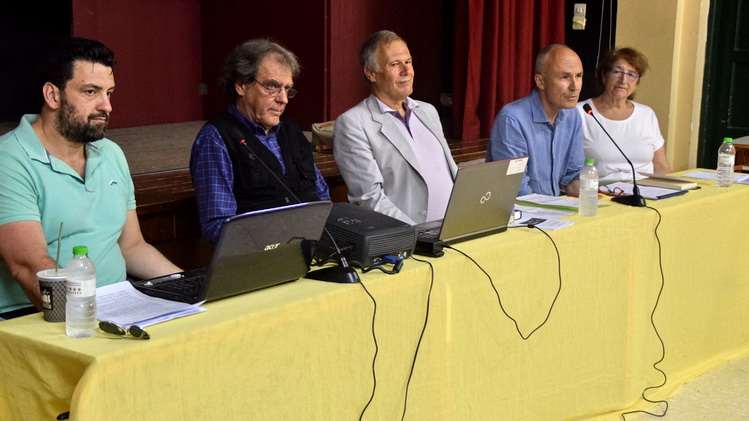
    At eight o’clock on 14th June in the auditorium of the First Primary School of Aegina an interesting function was held entitled “European Union and the Future”. The aim of the function was to examine present prospects for the European Union and discuss them, following the recent elections. Organized by the Aegina Association of Active Citizens, the function was introduced and moderated by Mr. Stratos Pantavos.

    The speakers were William Mallinson, professor in Political Ideas and Institutions at the Guglielmo Marconi University in Italy, the journalist Vasso Kanellopoulou and Nikos Vakolidis, founding member of Greek section of the international defence group for Julian Assange Unity4j.

    Stratos Pantavos: Good evening.  Thank you HP, the president of the Association of Active Citizens, who launched today’s talks and meeting, on a subject in which the Active Citizens have been very much involved in recent years, the subject of Europe, Greece’s entry into Europe, our relations as citizens with Europe, and the future of Europe, concern about Europe, are something that we have been engaged with for a very long time, starting from what seems distant now, 2008, when we organized the very significant day-conference entitled “Capodistrias Spinelli Europe“, a very powerful function. And subsequently we proceeded, in 2012, with a meeting – right at the height of the crisis, in the dark years of the crisis, on the subject of Philhellenism, and the slogan “We are all Greeks”, and that too met with a strong response at that time. After that we organized another very interesting day-conference. The theme was once again was “Europe: disintegration or a new beginning“. We had invited a very well known and exceptional speaker, Giulietto Chiesa.

    Today we are proceeding again with this subject of Europe and the result from the elections, which were held two weeks ago, is very fresh. They were elections which made us all very much afraid that they would mark the disintegration of Europe, but fortunately, we could say, the results were not so catastrophic. Certainly there was a rise of the populists at the European level with the extreme case being Italy, which has become the epicentre  of the European populists. But at the same time there was an increase in the Greens and other combinations, both in Germany and in France  and what we could say is that the positive element in the whole situation we that for the first time after twenty-five years the percentage of participation in these European elections was over fifty percent. Young people were the big question mark in this case and in the runup to the European elections there was great unease over how far  young people would come out because generally they have an attitude of abstention from these processes. We can say that this time young people did go to vote from what has been shown by the various analyses that have been made. And to a great extent in countries like France for example, they gave their vote to the Green movements. Without wanting to say that we are making propaganda for the Greens, they are certainly a counterweight to the promotion of the populists.

    In today’s discussion the procedure we will be following is this: we first have to see a video which was made in 2013 with Dastoli, who was the secretary of Spinelli. Spinelli, for those who don’t know, is a man who conceived the European idea and in 1941-42 together with Rossi, when they were political prisoners in Italy, wrote the manifesto for Europe, for free, united Europe. The principles of the manifesto as they were written then, might be said to be valid today. They spoke of a Europe without borders, they spoke of a Europe with a uniform external policy, they spoke of a Europe with a defence policy, a monetary policy, all of these uniform. To what extent these ideas have been realized is another question, but along with some other issues that have been added today, such as those of refugees, and of the environment, which are very important, they are very closely linked to policy, they are once again at the heart of the matters that concern us as European citizens. So we will start with this video with Dastoli, which was made about five years ago, more or less at the time of our function with Giulietto Chiesa, and after that we will have the opportunity to hear our three speakers: William Mallinson, Nikos Vakolidis and Vasso Kanellopoulou, and at the end open discussion.

    Political Alternatives

  • Function of honour and tribute at monument in Tourlos to the executed political prisoners

    For the second consecutive year on 1st May a function of commemoration and tribute was organized by the local SYRIZA group of Aegina and held in the naval base at Tourlos, honouring the political prisoners executed during the German occupation and the subsequent civil war. Participating in the function were the Alternate Minister for Social Solidarity Theano Fotiou, the SYRIZA Europarliamentarian Stelios Kouloglou, the SYRIZA national parliamentarians for Piraeus 1st District and for the Islands Thodoros Dritsas and Eleni Stamataki and the SYRIZA parliamentarian for Athens 2nd District Christoforos Papadopoulos.

    On behalf of the SYRIZA chapter in Aegina the municipal councilor Antonis Delis explained the reasons why the function is being held. A text on the history of the day was read by the medical doctor Mr. Giorgos Bogris

    In the course of the function a number of the participants laid wreaths and flowers on the monument. The co-ordinators of the local group Mr. Panagiotis Patsakios laid a wreath and flowers were presented by Mesdames Fotiou and Stamatakis, Messrs Dritsas, Kouloglou and Papadopoulos, the mayor of Aegina Dimitrios Mourtzis and the granddaughter of “Captain Moria” Georgakopoulos.
    The function was also attended by the president of the social organization of the Municipality of Aegina KEDA Mrs. Kaiti Salpea, the Deputy Mayor Panagiotis Marmarinos, the councilor Nektarios Leousis, and numerous citizens.

    Address by the Mayor of Aegina Dimitrios Mourtzis

    I am with you to express my emotion, to condemn those who wish to stigmatize a different ideology, those who since seventy-one years ago when the last execution took place here unfortunately have not realized that in this country we are who we are, we are Greeks, we are Hellenes, we are Greece, without dividing lines, with different viewpoints, with the ideology of mutual respect, an ideology that is the greatest ideal we have within us, within our conscience, and it is not possible for anyone to take this ideology away from us. My hope is that the actions that took place here will never again occur in our country. This day that we are here I wanted all the groupings of the parliament to be here. Whatever mistakes there were, the policies behind them are to be condemned and we should show by our presence that something has changed in this Greece that is struggling to move beyond these narrow confines that have been imposed on us.

    I came here as mayor, with great emotion but also as a Hellene, to say that my presence here is necessary, irrespective of whether I represent, in an honorary capacity, this region. I come here as Dimitrios Mourtzis, to present, along with the condemnation of this behaviour, the message that we must at long last stop what has been plaguing us for so many years. The last execution took place here seventy-one years ago. Seventy-one years passed, unexploited. I address my friends the ministers that I see facing me, my friends of the Greek parliament, all the members of the municipal council, all the people who came here to declare their concern.

    Statements by Theano Fotiou, Thodoris Dritsas and Eleni Stamataki on the commemorative function at Tourlos

    Statements on the function at the monument in Tourlos to the political prisoners executed during the German occupation and the subsequent civil war were made to Aegina Portal after the end of the ceremony by the Alternate Minister for Social Solidarity Theano Fotiou and the SYRIZA parliamentarians for Piraeus 1st District and the Islands Thodoris Dritsas and Eleni Stamataki.

    Theano Fotiou: “It is the first time for me that I am celebrating May Day in this way, honouring the executed activists of the National Resistance, and indeed in Aegina. Truly for me the whole function was serious. It was an opportunity for reflection on exactly what happened. On the one hand let us not forget, on the other let us learn and never ever allow fascism to raise its head again.

    Thodoris Dritsas: “For a second time this year we see this marvellous initiative by the SYRIZA local organization in Aegina to commemorate the activists held in the Aegina prison and then executed at Tourlos in the period between 1940 and 1944 and subsequently 1947 to 1949. Justice, progress, peace, vindication of the struggles of these people gave their lives for the highest ideals. The participation of local government, the mayor and many other representatives of Aegina society is very promising and paves the way for this initiative to be embraced by all the social and political forces of Aegina. It is a worthwhile objective within the prospect of peace, progress and vindication of the struggles of the Greek people.”

    Eleni Stamataki: “For us today is not a day of celebration. It is a day of commemoration and tribute. We remember and honour those who struggled, throughout the world, for equal rights and equal conquests and this is why we are here, on this sacred site where eighteen activists of the National Resistance were executed, surreptitiously and illegally. They are the ones we honour today.

  • Has the European Union been a bad idea?

    As a first (and hopefully not last) step towards an objective discussion of today’s situation of the European Union, outside of the logic of parties, parliamentary and “media” conflict, on 16th July there was, with the compliments of Mr. Paschalis and Mrs. Salomi Melissaris, a screening of an extract from the paper presented in 2009 by Mr. Ioannis Coccalas, entitled “From Altiero Spinelli’s Draft to the Treaty of Lisbon”. As Deputy Director of the European Parliament’s office in Athens, Mr Coccalas was at that time one of the speakers at the “Ioannis Capodistrias, Altiero Spinelli, Europe” conference held on 21st June 2009 in Aegina.

    An introduction to the 16th July screening was presented by Wayne Hall, member of the steering committee of the Aegina Association of Active Citizens.

    21

    INTRODUCTION

    I would like us to be in agreement that in today’s discussion it will not be relevant whether we voted YES or NO in the referendum, whether it is mainly Simitis and Papandreou, Samaras and Venizelos, or Tsipras and Varoufakis who are most to blame for the present situation in Greece. I would like us to agree also that it is not going to be relevant today whether we prefer Greece to remain in the euro or to leave the euro. In any case this is a question that is not going to be decided by ordinary Greek citizens, at least for the moment. The conflict that is so evident in the Parliament around that subject, among others, is something we can monitor. The conflict in the mass media, in the talk shows, in the journalistic squabbles is something it is perhaps preferable for us not to watch, because as it seems its main purpose is to frighten us rather than inform us.

    The question of the media is of central importance. I think that even citizens who voted YES must have been at least uneasy about the stance taken by the Greek and international media in the week that preceded the referendum. This problem is also at the heart of the Appeal by German Greeks and Greek Germans and the Greek answer that was formulated by representatives of the three associations of Aegina: the Association of Active Citizens, the Ioannis Capodistrias Cultural Association and the Women’s Association.

    Professor Juergen Link, who initiated the Appeal by German Greeks and Greek Germans, proposes a seminar on the problem of the media, which in Germany cultivate hatred of Greeks and in Greece hatred of Germans. In reality what is needed is more than a seminar. What is needed is a form of pan-European politics that is not influenced by the media, which places a negative stigma on every influence from this direction. This is perhaps something for discussion among those who would like to be actively involved in such a project of delinkage from the media. We have already made a beginning with the programme we made in 2013 on the VMedia web channel Europe Starts from Here.

    In any case let us agree that for the purposes of today’s discussion it is not relevant which Greek politician has played the worst role. The subject is not Greek internal politics, or even Greece in general. The subject is Europe, the European Union, because the European Union as we have known it – this was written a day or two ago by the Irish journalist Fintan O’Toole – ended last weekend.

    European integration was based on three assumptions, three conditions. The first condition was that the process was consensual: each member state lost more and more of its sovereignty because it was choosing of its own free will to do so. The second term was that this step-by-step procedure was irreversible. This was the terminology of the Treaty of Maastricht on the subject of monetary union. It was not part of the scenario that you could change your mind and go back. Neither could others change their mind about you and send you back. The third assumption was implicit and had to do with the role of Germany. As we know, Germany was defeated in WorldWar II, and badly defeated. In return for the opportunity to make a new beginning after this defeat it was considered self-evident that Germany would not try yet again to become the hegemon of Europe.

    Today Germany is not only trying to become the hegemon of Europe. It is succeeding in becoming the hegemon of Europe. I suppose that most of us here will have seen yesterday’s address to Parliament by Yanis Varoufakis. Not everyone admires the role that Varoufakis has played, but I think the conclusions of that address will be generally accepted.

    Varoufakis calls the so-called agreement that has just been voted by Parliament a “new Treaty of Versailles”. But most SYRIZA parliamentarians supported it, for the sake of the unity of SYRIZA. “We in SYRIZA are and will be united, at the time that Europe strikes a blow against itself through procedures that the historian of the future will describe as the moment of dismantling of the dream of Adenauer, Constantine Caramanlis, Andreas Papandreou, Willy Brandt, Helmut Schmidt and Helmut Kohl.”

    There was uproar in the Parliament after the speech by Varoufakis. Outside the Parliament, also, there was pandemonium. Here we are not shouting, we are not denouncing, and the reason for that is not concern for the unity of SYRIZA. I hope that our concern here is for the citizens of Greece to remain united at this conjuncture. And the hope is also, perhaps, that just as in 1828 when the modern Greek state was founded in Aegina, this island will function today also as a haven of stability and security within the chaos of Greece.

    The question we put forward is “Has the European Union been a bad idea?” We raise it not as a declaration but as a question. Certainly the man we are going to hear now does not believe that the priority is to leave the euro, or the European Union. But is he right or wrong?

    kokkalas

    The video can be found online here.

    Note that in 2009 Ioannis Coccalas saw not Germany but France as the key obstacle to the whole European integration process. Those who are now embracing the French campaign for a Germanexit should bear that in mind. (More on that here).

    16th July 2015


  • AEGINA (introduction to the 3-volume history by Georgia Koulikourdi)

    As is well-known, the island of Aegina has been an enduring historical presence in the Greek lands. This can be attributed both to the nature of its soils and to its geographical location.

    The composition of the soil, the climate, the water reserves, the configuration of the coastline, all create the conditions for support of a permanent population of between five and six thousand inhabitants. Its geographical position, virtually at the centre of the Saronic Gulf, makes possible a great increase in this demographic potential.

    As a result, Aegina, unlike the rest of islands of the Saronic Gulf, has been continuously inhabited since 3500 B.C. and so possesses important monuments from all historical periods. It could therefore be an ideal centre for studying Greek civilization as a whole.

    The mythical tradition of Aeacus and the Aeacidae reflects the political, economic and cultural significance of Aegina at its zenith. Particularly emphasized is the notion that the Aeginetans were descended from the island’s ants, making them a people indigenous to the island.

    In its long history, Aegina has gone through periods of great prosperity. Especially during the Archaic age (734 B.C. – 459 B.C.) it became an important naval and mercantile power due to its geographical position. It conducted transit commerce with all of the ports of the Mediterranean and accumulated great wealth. Furthermore, the Aeginetans were the first people in the Greek lands to employ silver as a medium of exchange, minting a silver state coin, the chelona, from metal mined from the island’s own deposits.

    The same period saw a flourishing of the arts of architecture and sculpture. The school of Aegina comprised a number of great artists who received commissions from far and wide. Significant activity is also to be noted at the same time in the field of athletics. Aeginetans emerged victorious in over thirty Panhellenic and local games, many of which were extolled by Pindar, the great Theban poet, who numbered among Aegina’s closest friends. These victories were achieved mostly by children and adolescents, as the adults were busy with commerce and seafaring.

    This activity laid the foundation for a prosperous civil society, creating a remarkably powerful class of capital-holding ship owners, which reigned supreme. Numerous struggles by supporters of democracy failed to topple it.

    Starting at the end of the 6th century BC, the social and political changes in Athens generated sharp conflict between the oligarchs in Aegina and the democrats in Athens. The latter seem to have secretly supported the democratic forces on the island in their struggle to topple the oligarchy.

    The social and political conflicts, along with Aegina’s commercial interests in the Dardanelles, go towards explaining the fact that the Aeginetan oligarchs made an offering of earth and water, tokens of subjugation, to Darius, King of Persia, on the eve of the Greco-Persian Wars. When Xerxes later launched his campaign of conquest of Greece, however, the Aeginetans fought alongside the other Greeks, and distinguished themselves in combat. Pytheas, son of Ischenoos and an Aeginetan, fought so bravely in the naval battles around Artemision that he inspired the admiration of even the Persians themselves . In Salamis, Aegina came first among the Greek city-states and Polykritos, son of Krios, was decorated as the bravest fighter.

    After the wars the conflict between Athens and Aegina sharpened even further. The Athenian democracy, inaugurating its imperialist policies and claiming its naval supremacy, programmed the eradication of the Aeginetan state, which was closing the gates of the Saronic Gulf, having formed close ties with the rival Dorian coalition. The oligarchs in Aegina relied on their naval tradition and superiority and did not update their naval power. The result was defeat, military and economic devastation (468 B.C.) and, with the start of the Peloponnesian war (431 B.C.), the removal of the entire population and the installation of Athenian settlers on the island. The Aeginetans who managed to survive returned to their homeland after the end of the war (404 B.C.) with the support of the Spartans, who in turn expelled the Athenian settlers.

    Nevertheless, there were also Aeginetan democrats, who were friendly towards Athens. Many of them helped the Athenians dispose of the thirty tyrants and, as can be inferred from a relevant tablet, some later took up residence in Piraeus.

    In the 4th century B.C. a politically and economically weakened Aegina took part in the Corinthian war on the side of Sparta. The Spartans used the island as a base for surprise attacks on the port of Piraeus and operations in the Saronic Gulf in general. In the second half of the 4th century B.C. the island was relegated to the status of a luxury resort where the rich would spend their summers and winters.

    In the Hellenistic period the island was sold by the Aetolians to Pergamon, later passing together with Pergamon into the possession of the Romans. It was used at that time as a naval base, where Roman and Pergamine fleets would anchor and often winter. The Pergamine period seems to have been a time of considerable prosperity for the island, to judge by the number of remaining rock-hewn tombs, monuments and other finds.

    In the early Christian years, the Gothic and Herulian raids in mainland Greece and the Peloponnese forced the residents of the neighbouring coastal areas to seek shelter in Aegina. The island’s population increased sharply and the refugees’ needs for housing and fortifications resulted in the destruction of almost all the ancient city’s monuments. But prosperity returned to the island during this period. The city grew populous. The traces of three large parish basilicas—in Panagitsa, close to the Metropolis (Cathedral), in Agios Nikolaos, and in Vardia, along with a synagogue in Karantina—testify to the extent of the city and the existence of a large Jewish community.

    From the 8th century A.D. until the 10th century A.D., extensive Saracen pirate raids forced part of that population to emigrate. The rest retreated to the island’s interior and built a new capital, known today as Palaia Hora (Old Capital).

    The year 1204 ushered in a protracted period of subjugation to various occupiers: the Franks (1204 A.D. – 1417 A.D.), the Catalans (1317 A.D. – 1451 A.D.), the Venetians (1451 A.D. – 1540 A.D. and 1687 A.D. – 1715 A.D.) and the Turks (1540 A.D. – 1687 A.D. and 1715 A.D. – 1821 A.D.). In each case it was the port of Aegina that served as the occupier’s naval base. The people suffered from exploitation by the foreign rulers, from the Turkish-Venetian wars and the from successive pirate raids. Thousands of Aeginetans were imprisoned or slain.

    The greatest disaster took place in 1537 A.D. Hayreddin Barbarossa, an admiral under the Sultan Suleyman II, occupied Aegina, which was a Venetian base at the time, and captured a large number of inhabitants—estimates range from 4,000 to 7,000, depending on the source. The destruction was so extensive that the impression was left of the island having been depopulated completely, as a result being resettled later by Albanian-speaking Greeks from the surrounding areas. On closer scrutiny, however, this idea has been shown to be false. Despite the successive disasters, the Aeginetan people did manage to survive and preserve their language, their orthodox tradition and their customs. Immigrants to the island, as well as the occasional refugees who elected to stay, were not numerous and assimilated into the local culture. Of course, due to the various disasters, the island became degraded both demographically and economically. The population declined and commerce and shipping contracted. Under these circumstances, unlike Hydra and Spetses, Aegina failed to benefit from the favourable conditions of the 18th century and grow wealthy. Another contributing factor to this was that the residents had the option of living off agriculture and were not obliged to seek a livelihood exclusively in commerce or seafaring. At the beginning of the 19th century the island was therefore predominantly agricultural, with limited seafaring activity.

    From the end of the 18th century, when some degree of safety began to return to the Saronic Gulf, the Aeginetans abandoned Palaia Hora, went back to the coast and settled where the ancient city used to stand, next to the old ports.

    Around 400 Aeginetans took part in the Greek Revolution of 1821. In its course, Aegina sheltered thousands of refugees and became the seat of government in 1826 and 1827. In 1828 and 1829 it became the capital and the centre for governor Capodistrias’ political, administrative, economic and cultural activity.

    As the end of the 19th century and the beginning of the 20th century approached, the development of sponge diving initiated another economic boom period, which ended, however, with the decline of sponge diving in the mid-20th century. The Aeginetans did not apply themselves to finding an alternative. In the meantime, there had been an intense wave of migration to North America, prompted by the sponge diving and culminating in the founding of Tarpon Springs, Florida, the only modern-day Aeginetan community outside of Aegina. It was also around this time that the great two-story neoclassical and bourgeois residences in the town and in Kypseli were built, giving Aegina its contemporary architectural character.

    Today Aegina lives off its pistachio cultivation and its heavy tourist traffic. Demand for houses and hotels has brought about intensive but chaotic and unplanned construction, which has degraded the environment, e.g. in Agia Marina. Thankfully, the pistachio cultivation has put something of a brake on more total predomination by real estate speculation.

    The Aegina of today has, as in the past, a great deal of potential. A more systematic approach to agriculture together with modern planning; the development of cottage industry and artisanship; proper organisation of voluntary associations; the protection of pistachio production; utilisation for scientific and social purposes of the Capodistrian buildings, which have been allowed to fall into ruin, and proper touristic development of the South-Eastern parts of the island, such as Mt. Ellanion and the traditional villages in the surrounding area, would lead to a more balanced and stable social and economic progress, all without neglecting maritime development, commerce and tourism, which are the foundations of the island’s economic life. The basic condition is that the environment and sea be protected. Without its beautiful shores and clean seas Aegina cannot survive, economically or in any other way.

    (Translation by Dimitris Hall)