https://www.youtube.com/watch?v=35-VdbC_bgI
Category: European Integration / Democracy
-
European Union and the Future? Function on the prospects for the European Union
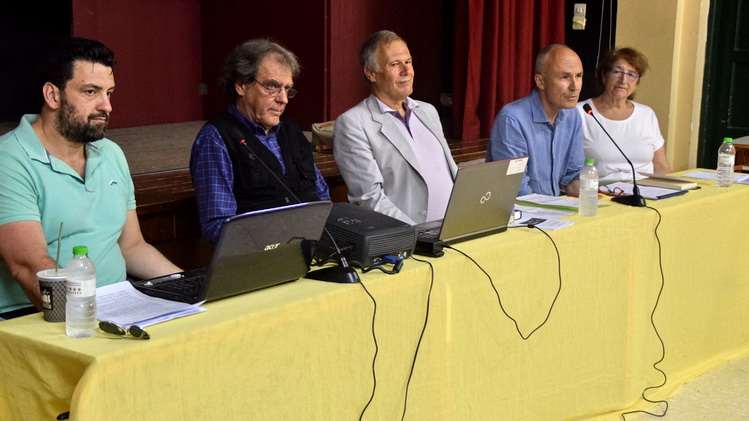
At eight o’clock on 14th June in the auditorium of the First Primary School of Aegina an interesting function was held entitled “European Union and the Future”. The aim of the function was to examine present prospects for the European Union and discuss them, following the recent elections. Organized by the Aegina Association of Active Citizens, the function was introduced and moderated by Mr. Stratos Pantavos.
The speakers were William Mallinson, professor in Political Ideas and Institutions at the Guglielmo Marconi University in Italy, the journalist Vasso Kanellopoulou and Nikos Vakolidis, founding member of Greek section of the international defence group for Julian Assange Unity4j.
Stratos Pantavos: Good evening. Thank you HP, the president of the Association of Active Citizens, who launched today’s talks and meeting, on a subject in which the Active Citizens have been very much involved in recent years, the subject of Europe, Greece’s entry into Europe, our relations as citizens with Europe, and the future of Europe, concern about Europe, are something that we have been engaged with for a very long time, starting from what seems distant now, 2008, when we organized the very significant day-conference entitled “Capodistrias Spinelli Europe“, a very powerful function. And subsequently we proceeded, in 2012, with a meeting – right at the height of the crisis, in the dark years of the crisis, on the subject of Philhellenism, and the slogan “We are all Greeks”, and that too met with a strong response at that time. After that we organized another very interesting day-conference. The theme was once again was “Europe: disintegration or a new beginning“. We had invited a very well known and exceptional speaker, Giulietto Chiesa.
Today we are proceeding again with this subject of Europe and the result from the elections, which were held two weeks ago, is very fresh. They were elections which made us all very much afraid that they would mark the disintegration of Europe, but fortunately, we could say, the results were not so catastrophic. Certainly there was a rise of the populists at the European level with the extreme case being Italy, which has become the epicentre of the European populists. But at the same time there was an increase in the Greens and other combinations, both in Germany and in France and what we could say is that the positive element in the whole situation we that for the first time after twenty-five years the percentage of participation in these European elections was over fifty percent. Young people were the big question mark in this case and in the runup to the European elections there was great unease over how far young people would come out because generally they have an attitude of abstention from these processes. We can say that this time young people did go to vote from what has been shown by the various analyses that have been made. And to a great extent in countries like France for example, they gave their vote to the Green movements. Without wanting to say that we are making propaganda for the Greens, they are certainly a counterweight to the promotion of the populists.
In today’s discussion the procedure we will be following is this: we first have to see a video which was made in 2013 with Dastoli, who was the secretary of Spinelli. Spinelli, for those who don’t know, is a man who conceived the European idea and in 1941-42 together with Rossi, when they were political prisoners in Italy, wrote the manifesto for Europe, for free, united Europe. The principles of the manifesto as they were written then, might be said to be valid today. They spoke of a Europe without borders, they spoke of a Europe with a uniform external policy, they spoke of a Europe with a defence policy, a monetary policy, all of these uniform. To what extent these ideas have been realized is another question, but along with some other issues that have been added today, such as those of refugees, and of the environment, which are very important, they are very closely linked to policy, they are once again at the heart of the matters that concern us as European citizens. So we will start with this video with Dastoli, which was made about five years ago, more or less at the time of our function with Giulietto Chiesa, and after that we will have the opportunity to hear our three speakers: William Mallinson, Nikos Vakolidis and Vasso Kanellopoulou, and at the end open discussion.
Political Alternatives
-
Democracy Best Practices: Direct? Electronic? Representative?
Hellenic American Democratic Association
Speakers:
1. Wayne Hall (Direct Democracy)
2. John Lewis (Electronic)
3. Karen Lee (Representative)
The discussion took place at the Athens Center, Pangrati in Athens, on September 21st 2015.
-
Open letter to Yanis Varoufakis: Plan B is democracy
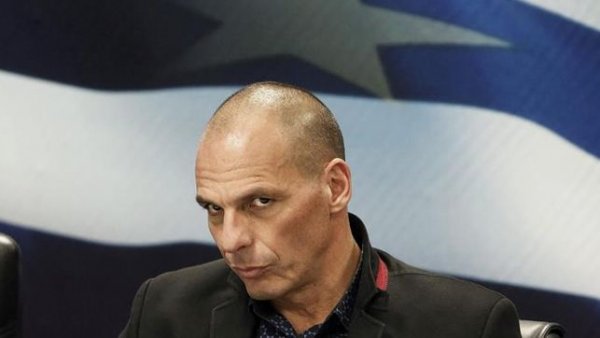
Dear Yanis Varoufakis,
For five months, you have personified the hopes of many European citizens. You have brought a wind of intellectual rigor and honesty in the circle of gray men of the Eurogroup. You tried tenaciously to respect the mandate of Greek voters: breaking up with the austerity policies while remaining within the euro area. But late June, the zombies of the Eurogroup and the Council, reinforced by the isolation of Greece and weak solidarity movements in Europe, sent you an ultimatum: submit or leave the euro.
The victory of the “no” in the July 5th referendum had reinforced your legitimacy to refuse the diktat of creditors. On July 13th you revealed |1| the proposal you made to Alexis Tsipras on the night of the referendum, “a triptych of actions” to avoid submission: “issue IOUs” (acknowledgments of debt in euros, that is to say a complementary currency based on tax revenues), “apply a haircut on Greek bonds” held by the ECB since 2012 in order to reduce the debt, and “take control of the Bank of Greece from the hands of the ECB.” But Alexis Tsipras refused this plan and accepted your resignation.
On July 20th, at the Greek Parliament, you voted against the ‘Agreement’ of July 13th indicating the decisive point: “when society begins to feel in his gut the pain of the disastrous results of the new austerity plan, when young and older people will take the streets or remain desperate at home, faced with these effects, who will from now on represent those people we were the voice in the political arena?”.
The unity of Syriza, the tool patiently wrought by the Greek left, is precious. It seems that this is why you do not have publicly led the debate on your alternative proposals: “ “Was there an alternative?” the Prime Minister asked me last Wednesday. I believe that, yes, there was. But I’ll say nothing more. This is not the moment to discuss again. The important thing is that on the evening of the referendum, the Prime Minister said that there was no alternative. ”
Yet this choice made by Alexis Tsipras to capitulate, and worse, to implement himself the demands of the creditors, is tragic. Like you, we can only be frightened by the political consequences of July 13th: the radical left, brought to power and confirmed by referendum in its legitimacy to break with austerity, appeared not only as unable to refuse an austerity plan that destroys democracy, but also willing to manage it by herself. Even assuming that no other option is available in the short term, returning to the opposition, as you wished, would have better preserved the future.
But if a plan B was possible, as you think, then the mistake is even more tragic. This crucial debate is rising today in the European left. The Left Platform of Syriza has made a proposal on May 24th for the suspension of debt payments and nationalization of banks. Éric Toussaint suggested on July 13th a more comprehensive set of measures |2|, acknowledging the fact, now for all to see, that breaking with austerity implies a unilateral policy of necessity and urgency that will obviously be equated with disobedience by EU leaders of the day, although it does not necessarily violate existent treaties |3|.
Contrary to what assert such respectable figures as Etienne Balibar, Sandro Mezzadra and Frieder Otto Wolf |4|, such alternative proposals cannot be described as”authoritarian and unworkable concepts of ’control’ of monetary policy and capital flows “. Similarly, when the great sociologist Boaventura de Sousa Santos states that”if a country showed disobedient, it would be expelled and chaos would become inevitable“ |5|, one can oppose that, given the content of the July 13th “agreement”, chaos is assured if the country complies.
Pablo Iglesias, leader of Podemos, does not either see any alternative to the July 13th “agreement”, “the only thing we can do,” “the truth of power” |6|. But if there is no alternative, if no European country can break up with austerity without sinking into chaos – and there can be little doubt that Spain, Italy or France would face as such considerable obstacles as Greece |7| – the neoliberal trap is flawless. If no single country can take a step aside and engage in another route to show the way, the only remaining possibility is to maintain verbally the perspective of “another Europe” while waiting for a pan-European political crisis and / or a systemic collapse of the eurozone that would put all countries in the same boat.
For years, with others, we opposed to those who claim that exiting the eurozone is a prerequisite to any alternative policy. Leaving the euro has important economic and political costs for the country concerned. Also, to point “Germany” as the main culprit, and to advocate the return to the national scope of powers as the prerequisite for any solution, is a serious mistake that neglects the overwhelming responsibility of all national elites in the present situation while feeding the nationalist ethos.
However we believe just as you that there are credible alternative economic and monetary policies that could be undertaken unilaterally. Bold policies, for sure, but perfectly reasonable and certainly preferable to the certainty of the economic and political disaster the “agreement” of July 13th will lead. We believe just as you that Greece, in the present situation of necessity and urgency, could – and still can – unilaterally declare a moratorium on its debt, create a complementary currency, requisition the Central Bank and nationalize banks, establish an effective taxation of wealthier classes (remember that Greek employees and pensioners, subject to VAT on their consumption and the withholding of their income tax, cannot defraud).
These measures certainly involve risks, especially if they are improvised in haste: bank run, flight from the complementary currency, increased capital flight … But the stronger popular support will be, the weaker the risks. The success of the June referendum and the unpopularity of the July 13th “agreement” show that a large social base potentially exists in Greece to support a policy based on dignity and justice, values that were trampled by creditors. This policy could give hope to the European peoples and strengthen their solidarity so far insufficient.
Such unilateral measures will probably lead creditors to want to expel Greece from the eurozone, although this would greatly reduce their chances of being finally repaid. Furthermore they lack a legal basis for doing so, and such a sanction would aggravate EU internal geopolitical contradictions. To castigate a country that is bravely trying to get out of the abyss and solve its humanitarian crisis could have significant political costs for the gray men. The debate aroused could strengthen the construction of the European public space without which the necessary refoundation will remain wishful thinking. Because one thing is to turn its back on Europe as a culprit for all the problems; another is to demonstrate by action that one only can respect the will of voters and preserve the interests of the lower classes by breaking with the dictates of the gray men who have taken possession of the European Union.
Thanks to your clarity and tenacity during these months of negotiations, you and Alexis Tsipras were very close to provide this successful demonstration. Dear Yanis Varoufakis, you would be doing a great service to Greece and Europe by undertaking, in an open and public manner, the battle for Plan B, the struggle for democracy in Greece and the European Union.
Footnotes
|1| www.newstatesman.com/world-affairs/2015/07/exclusive-yanis-varoufakis-opens-about-his-five-month-battle-save-greece, published July 13
|2| Eric Toussaint, “Greece: Alternatives to the Capitulation”, cadtm.org/http://cadtm.org/Greece-Alternatives-to-the
|3| Attac and Fondation Copernic, Que faire de l’Europe. Désobéir pour reconstruire, Les liens qui libèrent, 2014
|4| Etienne Balibar, Sandro Mezzadra Frieder Otto Wolf: “Le Diktat de Bruxelles et le dilemme de Syriza », http://blogs.mediapart.fr/blog/ebalibar/190715/etienne-balibar-sandro-mezzadra-frieder-otto-wolf-le-diktat-de-bruxelles-et-le-dilemme-de-syriza
|5| Boaventura de Sousa Santos,”Fatal tests”, 23.7.2015
|6| www.europapress.es/nacional/noticia-pablo-iglesias-resignado-ocurrido-grecia-verdad-poder-20150716153300.html
|7| Unlike Greece, Spain finances its debt and huge deficit on the financial markets, but would face soaring interest rates in the event of testing an alternative policy.
Thomas Coutrot
Article and discussion from Open Democracy
- https://www.opendemocracy.net/can-europe-make-it/yanis-varoufakis-alex-sakalis/one-very-simple-but-radical-idea-to-democratise-eur#comment-2430052981
- GREEK TRANSLATION
Wayne Hall : As soon as Yanis Varoufakis, in an interview with Spiegel, aired his idea of a grassroots European Citizens’ Movement he was contacted by the Association of Active Citizens on the island of Aegina, where he lives when he is not in Athens or travelling, and asked to explain his proposal at a public meeting in Aegina. He verbally accepted the verbal invitation, which was later formalized in writing, and his verbal acceptance was announced by a representative of our association at a meeting of the Aegina Council on 26th August. Yanis Varoufakis later said on the telephone that he did not like it that this announcement had been made. It so happens that the mayor of Aegina is actively supportive of the idea of a movement of European Citizens and is on record as saying so publicly. http://main.cse-initiative.eu/?p=413 Mr. Varoufakis says that “it is not worth trying again in Greece” so it seems that this grass roots movement is not going to start from the grass roots of what Yanis Varoufakis has been proud to advertise as “his territory”. As far as I know the invitation that was issued last summer is still open to be taken up and as well as explaining his concept of the European Citizens’ Movement Mr. Varoufakis will be free to explain his conception of the grass roots and in what way the movement he wants to start does not have designs of becoming a party, which would preclude it from being supported by the Aegina Association of Active Citizens.
Wickliffe
Mr Varoufakis keeps coming up against obstructions and threats from the power elites, which are blocking his attempts to challenge them through democratic means. Most of them are not as bright as he is, certainly not as honest, but have a massive and hidden power networks, and are willing to be brutal. He is probably aware that all avenues to further democracy are functionally blocked in Greece. Theory and practice are the same in theory (academia), but not in practice (Mafia).
Wayne Hall
1. I don’t have the sense that avenues to further democracy are more blocked in Greece than they are anywhere else, and I also do not know whether YV received threats that dissuaded him from following through on the undertaking he had given, verbally, to address a local meeting on his home territory, which is fertile ground for the ideas he has put forward…
2. Perhaps YV will end up trying to do something, in reverse, to what Cohn Bendit toyed with: the idea of standing as a candidate for the European Elections in Greece. Mr. Varoufakis might conclude that he has more of a constituency in Germany. Come to think of it, it might be the best thing for him to do, joining Die Linke, since he already cites Lafontaine as an ally. Cohn-Bendit, Spinelli and Capodistrias // Europe Starts From Here // Cohn-Bendit on Geoengineering Enouranois II
3. http://yanisvaroufakis.eu/2016…
Yanis Varoufakis said: “First, we need to establish the movement. This will happen on 9th February, in Berlin. Its purpose is to mobilise Europeans along a simple, common agenda: To democratise the EU’s institutions.
Once this ‘conversation’ begins in the context of an activist movement on what needs to be done (to democratise the EU), a consensus will emerge that must then find its expression in each of the member-states of the EU.
Exactly what electoral and organisational form this expression will take in each country is something that will be decided collectively, organically. In some countries it may take the form of a brand new party. In others our movement may forge an alliance with existing parties. This remains to be debated and decided.”
Comment: YV’s ideas and proposals at the institutional level are very, very, very confused. This will be Indignados Round Two.
-
Has the European Union been a bad idea?
As a first (and hopefully not last) step towards an objective discussion of today’s situation of the European Union, outside of the logic of parties, parliamentary and “media” conflict, on 16th July there was, with the compliments of Mr. Paschalis and Mrs. Salomi Melissaris, a screening of an extract from the paper presented in 2009 by Mr. Ioannis Coccalas, entitled “From Altiero Spinelli’s Draft to the Treaty of Lisbon”. As Deputy Director of the European Parliament’s office in Athens, Mr Coccalas was at that time one of the speakers at the “Ioannis Capodistrias, Altiero Spinelli, Europe” conference held on 21st June 2009 in Aegina.
An introduction to the 16th July screening was presented by Wayne Hall, member of the steering committee of the Aegina Association of Active Citizens.
INTRODUCTION
I would like us to be in agreement that in today’s discussion it will not be relevant whether we voted YES or NO in the referendum, whether it is mainly Simitis and Papandreou, Samaras and Venizelos, or Tsipras and Varoufakis who are most to blame for the present situation in Greece. I would like us to agree also that it is not going to be relevant today whether we prefer Greece to remain in the euro or to leave the euro. In any case this is a question that is not going to be decided by ordinary Greek citizens, at least for the moment. The conflict that is so evident in the Parliament around that subject, among others, is something we can monitor. The conflict in the mass media, in the talk shows, in the journalistic squabbles is something it is perhaps preferable for us not to watch, because as it seems its main purpose is to frighten us rather than inform us.
The question of the media is of central importance. I think that even citizens who voted YES must have been at least uneasy about the stance taken by the Greek and international media in the week that preceded the referendum. This problem is also at the heart of the Appeal by German Greeks and Greek Germans and the Greek answer that was formulated by representatives of the three associations of Aegina: the Association of Active Citizens, the Ioannis Capodistrias Cultural Association and the Women’s Association.
Professor Juergen Link, who initiated the Appeal by German Greeks and Greek Germans, proposes a seminar on the problem of the media, which in Germany cultivate hatred of Greeks and in Greece hatred of Germans. In reality what is needed is more than a seminar. What is needed is a form of pan-European politics that is not influenced by the media, which places a negative stigma on every influence from this direction. This is perhaps something for discussion among those who would like to be actively involved in such a project of delinkage from the media. We have already made a beginning with the programme we made in 2013 on the VMedia web channel Europe Starts from Here.
In any case let us agree that for the purposes of today’s discussion it is not relevant which Greek politician has played the worst role. The subject is not Greek internal politics, or even Greece in general. The subject is Europe, the European Union, because the European Union as we have known it – this was written a day or two ago by the Irish journalist Fintan O’Toole – ended last weekend.
European integration was based on three assumptions, three conditions. The first condition was that the process was consensual: each member state lost more and more of its sovereignty because it was choosing of its own free will to do so. The second term was that this step-by-step procedure was irreversible. This was the terminology of the Treaty of Maastricht on the subject of monetary union. It was not part of the scenario that you could change your mind and go back. Neither could others change their mind about you and send you back. The third assumption was implicit and had to do with the role of Germany. As we know, Germany was defeated in WorldWar II, and badly defeated. In return for the opportunity to make a new beginning after this defeat it was considered self-evident that Germany would not try yet again to become the hegemon of Europe.
Today Germany is not only trying to become the hegemon of Europe. It is succeeding in becoming the hegemon of Europe. I suppose that most of us here will have seen yesterday’s address to Parliament by Yanis Varoufakis. Not everyone admires the role that Varoufakis has played, but I think the conclusions of that address will be generally accepted.
Varoufakis calls the so-called agreement that has just been voted by Parliament a “new Treaty of Versailles”. But most SYRIZA parliamentarians supported it, for the sake of the unity of SYRIZA. “We in SYRIZA are and will be united, at the time that Europe strikes a blow against itself through procedures that the historian of the future will describe as the moment of dismantling of the dream of Adenauer, Constantine Caramanlis, Andreas Papandreou, Willy Brandt, Helmut Schmidt and Helmut Kohl.”
There was uproar in the Parliament after the speech by Varoufakis. Outside the Parliament, also, there was pandemonium. Here we are not shouting, we are not denouncing, and the reason for that is not concern for the unity of SYRIZA. I hope that our concern here is for the citizens of Greece to remain united at this conjuncture. And the hope is also, perhaps, that just as in 1828 when the modern Greek state was founded in Aegina, this island will function today also as a haven of stability and security within the chaos of Greece.
The question we put forward is “Has the European Union been a bad idea?” We raise it not as a declaration but as a question. Certainly the man we are going to hear now does not believe that the priority is to leave the euro, or the European Union. But is he right or wrong?
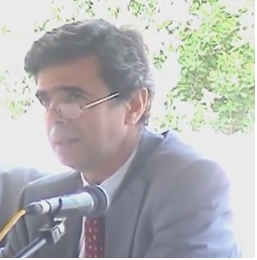
The video can be found online here.
Note that in 2009 Ioannis Coccalas saw not Germany but France as the key obstacle to the whole European integration process. Those who are now embracing the French campaign for a Germanexit should bear that in mind. (More on that here).
16th July 2015

