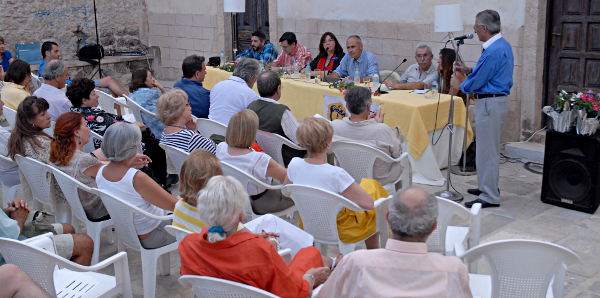
As a first (and hopefully not last) step towards an objective discussion of today’s situation of the European Union, outside of the logic of parties, parliamentary and “media” conflict, on 16th July there was, with the compliments of Mr. Paschalis and Mrs. Salomi Melissaris, a screening of an extract from the paper presented in 2009 by Mr. Ioannis Coccalas, entitled “From Altiero Spinelli’s Draft to the Treaty of Lisbon”. As Deputy Director of the European Parliament’s office in Athens, Mr Coccalas was at that time one of the speakers at the “Ioannis Capodistrias, Altiero Spinelli, Europe” conference held on 21st June 2009 in Aegina.
An introduction to the 16th July screening was presented by Wayne Hall, member of the steering committee of the Aegina Association of Active Citizens.


INTRODUCTION
I would like us to be in agreement that in today’s discussion it will not be relevant whether we voted YES or NO in the referendum, whether it is mainly Simitis and Papandreou, Samaras and Venizelos, or Tsipras and Varoufakis who are most to blame for the present situation in Greece. I would like us to agree also that it is not going to be relevant today whether we prefer Greece to remain in the euro or to leave the euro. In any case this is a question that is not going to be decided by ordinary Greek citizens, at least for the moment. The conflict that is so evident in the Parliament around that subject, among others, is something we can monitor. The conflict in the mass media, in the talk shows, in the journalistic squabbles is something it is perhaps preferable for us not to watch, because as it seems its main purpose is to frighten us rather than inform us.
The question of the media is of central importance. I think that even citizens who voted YES must have been at least uneasy about the stance taken by the Greek and international media in the week that preceded the referendum. This problem is also at the heart of the Appeal by German Greeks and Greek Germans and the Greek answer that was formulated by representatives of the three associations of Aegina: the Association of Active Citizens, the Ioannis Capodistrias Cultural Association and the Women’s Association.
Professor Juergen Link, who initiated the Appeal by German Greeks and Greek Germans, proposes a seminar on the problem of the media, which in Germany cultivate hatred of Greeks and in Greece hatred of Germans. In reality what is needed is more than a seminar. What is needed is a form of pan-European politics that is not influenced by the media, which places a negative stigma on every influence from this direction. This is perhaps something for discussion among those who would like to be actively involved in such a project of delinkage from the media. We have already made a beginning with the programme we made in 2013 on the VMedia web channel Europe Starts from Here.
In any case let us agree that for the purposes of today’s discussion it is not relevant which Greek politician has played the worst role. The subject is not Greek internal politics, or even Greece in general. The subject is Europe, the European Union, because the European Union as we have known it – this was written a day or two ago by the Irish journalist Fintan O’Toole – ended last weekend.
European integration was based on three assumptions, three conditions. The first condition was that the process was consensual: each member state lost more and more of its sovereignty because it was choosing of its own free will to do so. The second term was that this step-by-step procedure was irreversible. This was the terminology of the Treaty of Maastricht on the subject of monetary union. It was not part of the scenario that you could change your mind and go back. Neither could others change their mind about you and send you back. The third assumption was implicit and had to do with the role of Germany. As we know, Germany was defeated in WorldWar II, and badly defeated. In return for the opportunity to make a new beginning after this defeat it was considered self-evident that Germany would not try yet again to become the hegemon of Europe.
Today Germany is not only trying to become the hegemon of Europe. It is succeeding in becoming the hegemon of Europe. I suppose that most of us here will have seen yesterday’s address to Parliament by Yanis Varoufakis. Not everyone admires the role that Varoufakis has played, but I think the conclusions of that address will be generally accepted.
Varoufakis calls the so-called agreement that has just been voted by Parliament a “new Treaty of Versailles”. But most SYRIZA parliamentarians supported it, for the sake of the unity of SYRIZA. “We in SYRIZA are and will be united, at the time that Europe strikes a blow against itself through procedures that the historian of the future will describe as the moment of dismantling of the dream of Adenauer, Constantine Caramanlis, Andreas Papandreou, Willy Brandt, Helmut Schmidt and Helmut Kohl.”
There was uproar in the Parliament after the speech by Varoufakis. Outside the Parliament, also, there was pandemonium. Here we are not shouting, we are not denouncing, and the reason for that is not concern for the unity of SYRIZA. I hope that our concern here is for the citizens of Greece to remain united at this conjuncture. And the hope is also, perhaps, that just as in 1828 when the modern Greek state was founded in Aegina, this island will function today also as a haven of stability and security within the chaos of Greece.
The question we put forward is “Has the European Union been a bad idea?” We raise it not as a declaration but as a question. Certainly the man we are going to hear now does not believe that the priority is to leave the euro, or the European Union. But is he right or wrong?
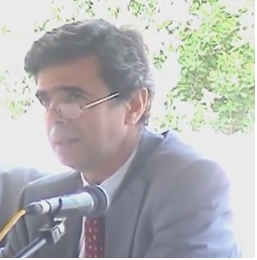
The video can be found online here.
Note that in 2009 Ioannis Coccalas saw not Germany but France as the key obstacle to the whole European integration process. Those who are now embracing the French campaign for a Germanexit should bear that in mind. (More on that here).
16th July 2015