Category: English

  • Inside Bannon’s Plan to Hijack Europe for the Far-Right

    Inside Bannon’s Plan to Hijack Europe for the Far-Right

    Bannon is moving to Europe to set up The Movement, a populist foundation to rival George Soros and spark a right-wing revolt across the continent.

    SOURCE

    LONDON—Steve Bannon plans to go toe-to-toe with George Soros and spark a right-wing revolution in Europe.

    Trump’s former White House chief advisor told The Daily Beast that he is setting up a foundation in Europe called The Movement which he hopes will lead a right-wing populist revolt across the continent starting with the European Parliament elections next spring.

    The non-profit will be a central source of polling, advice on messaging, data targeting, and think-tank research for a ragtag band of right-wingers who are surging all over Europe, in many cases without professional political structures or significant budgets.

    Bannon’s ambition is for his organization ultimately to rival the impact of Soros’s Open Society, which has given away $32 billion to largely liberal causes since it was established in 1984.

    Over the past year, Bannon has held talks with right-wing groups across the continent from Nigel Farage and members of Marine Le Pen’s Front National (recently renamed Rassemblement National) in the West, to Hungary’s Viktor Orban and the Polish populists in the East.

    He envisions a right-wing “supergroup” within the European Parliament that could attract as many as a third of the lawmakers after next May’s Europe-wide elections. A united populist bloc of that size would have the ability to seriously disrupt parliamentary proceedings, potentially granting Bannon huge power within the populist movement.

    After being forced out of the White House following internal wranglings that would later surface in the book Fire and Fury, Bannon is now reveling in the opportunity to plot his new European empire. “I’d rather reign in hell, than serve in heaven,” he said, paraphrasing John Milton’s Satan in Paradise Lost.
    The Movement’s headquarters are expected to be located in Brussels, Belgium, where they will start hiring staff in coming months. It is expected that there will be fewer than 10 full-time staff ahead of the 2019 elections, with a polling expert, a communications person, an office manager and a researcher among the positions. The plan is to ramp that up to more like 25 people post-2019 if the project has been a success.

    Bannon plans to spend 50 percent of his time in Europe—mostly in the field rather than the Brussels office—once the midterm elections in the U.S. are over in November.

    The operation is also supposed to serve as a link between Europe’s right-wing movements and the pro-Trump Freedom Caucus in the U.S. This week Paul Gosar (R-AZ) was its envoy to Bannon’s operation in London.

    Bannon and Raheem Kassam, a former Farage staffer and Breitbart editor, set up shop in a five-star Mayfair hotel for a week while Donald Trump was visiting Europe. Between TV appearances as Trump surrogates, they hosted a raft of Europe’s leading right-wingers at the hotel.

    “It was so successful that we’re going to start staffing up,” said Bannon. “Everybody agrees that next May is hugely important, that this is the real first continent-wide face-off between populism and the party of Davos. This will be an enormously important moment for Europe.”

    Having seen the shock right-wing victory with the Brexit referendum and Matteo Salvini’s electoral success in Italy, which were achieved on relatively tight budgets, Bannon sees the opportunity to boost radically disparate nationalist parties by deploying a well-financed centralized operation intended to blow local opponents out of the water.

    Up until now insurgent populist groups across Europe have often suffered from similar problems: lack of expertise and finances. Le Pen’s party was kept afloat by Russian loans back in 2014, when French banks refused to extend lines of credit for the Front National. Le Pen was back in Moscow shaking Putin’s hand before last year’s French elections, which the NSA subsequently revealed had been hacked by the Russians.

    The Movement plans to research and write detailed policy proposals that can be used by like-minded parties; commission pan-European or targeted polling; and share expertise in election war room methodology such as message discipline, data-led voter targeting and field operations. Depending on electoral law in individual countries, the foundation may be able to take part in some campaigns directly while bolstering other populist groups indirectly.

    “I didn’t get the idea until Marine Le Pen invited me to speak at Lille at the Front National,” recalled Bannon. “I said, ‘What do you want me say?’”

    The response came back: “All you have to say is, ‘We’re not alone.’”

    Bannon was stunned to discover that the nationalist movements in Europe were not pooling skills and sharing ideas with populist parties in neighboring countries—let alone on a global scale.

    Bannon said the Front National recognized that he was “the guy that goes round and understands us as a collective.”

    Up on stage he told the crowd: “You fight for your country and they call you racist. But the days when those kind of insults work is over. The establishment media are the dogs of the system. Every day, we become stronger and they become weaker. Let them call you racists, xenophobes or whatever else, wear these like a medal.”

    The former Trump campaign manager believes the fuse for the global populist revolt—now led from Washington, D.C. by his former boss—was lit 10 years ago during the financial crisis and President Barack Obama’s bailout of the broken financial sector. With income inequality growing, Bannon first championed Sarah Palin and then Donald Trump as vanquishers of the establishment elite who were capable of turning traditional politics on its head.

    His next populist heroes can be found in Europe.

    He sees Angela Merkel, the German chancellor, as the perfect foil to help accelerate that dynamic in Europe.

    Noting Trump’s controversial decision to call out Merkel over her gas pipeline deal with Russia last week, Bannon said: “This is the lie of Angela Merkel. She’s a complete and total phony. The elites say Trump is disruptive but she’s sold out control to Russia for cheaper energy prices.”

    He describes Merkel and Emmanuel Macron, the French president who crushed Le Pen in a runoff election last year but has since flagged in the polls, as vulnerable figureheads of establishment Europe. With Britain voting to quit the E.U., Merkel and Macron’s vision of a united continent will be put to the test at next year’s elections.

    Bannon is convinced that the coming years will see a drastic break from decades of European integration. “Right-wing populist nationalism is what will happen. That’s what will govern,” he told The Daily Beast. “You’re going to have individual nation states with their own identities, their own borders.”

    The grassroots movements are already in place waiting for someone to maximize their potential. “It will be instantaneous—as soon as we flip the switch,” he said.

    The sight of Brexit virtually upending the entire European Union with a campaign spending cap of £7 million ($9 million) was a great inspiration. “When they told me the spending cap was £7 million, I go, ‘You mean £70 million? What the fuck?!’ £7 million doesn’t buy anything. It doesn’t buy you Facebook data, it doesn’t buy you ads, it doesn’t do anything.”

    “Dude! You just took the fifth largest economy in the world out of the EU for £7 million!”

    This week, British officials ruled that the Brexit campaign had not stuck to the legal limit—overspending by more than $600,000. There were also unofficial campaigns which spent additional millions arguing that Britain should leave the E.U.

    Nonetheless, Britain’s GDP is around $2.6 trillion and leaked government figures estimate that Brexit could wipe 10 percent off that figure, meaning the impact of the democratic decision vastly dwarfs the scale of the investment by the campaign.

    “The first thing they teach you at Harvard Business School is operating leverage,” said Bannon. With his expertise, contacts and financial backing, he is convinced that he can have an outsized impact all across Europe.

    Bannon went to Italy to observe the campaign earlier this year as populist parties surged in the polls despite their tiny operations. “Look at Five Star and the Northern League,” he said. “They used their own credit cards. They took control of the seventh largest economy in the world—on their credit cards! It’s insane.”

    The two anti-establishment parties reached a coalition agreement that made Matteo Salvini deputy prime minister and put him in charge of the interior ministry two months ago. He has since shut Italy’s ports to NGO ships carrying rescued migrants and called for a census of the Roma community that may lead to mass deportations. Last year, he called for a radical crackdown on immigrants. “We need a mass cleansing, street by street, piazza by piazza, neighborhood by neighborhood,” he said.

    Bannon sees Salvini as a model for his future Movement partners to follow. “Italy is the beating heart of modern politics,” he said. “If it works there it can work everywhere.”

    He admitted that the scale of his right-wing coalition could be limited by the extreme positions of some of The Movement’s potential partners. “Some people may opt out because they think some of the guys may be too immigrant focused,” he conceded.

    “We’re not looking to include any ethno-nationalist parties in this although guys like the Sweden Democrats or the True Finns are perfect casting.”

    Kent Ekeroth of the Sweden Democrats was one of those who met Bannon in Central London in the last week. The party, which had its roots in the Neo-Nazi and white supremacist movements of the 1980s, has shot up to almost 20 percent in recent polls after adopting a more conventionally populist, anti-immigration message.

    Jérôme Rivière of Marine Le Pen’s Front National (Rassemblement National since June) also made the pilgrimage to London’s Mayfair, as did Mischaël Modrikamen of the People’s Party of Belgium, Nigel Farage of UKIP and Filip Dewinter of Vlaams Belang, a Flemish nationalist party formed in 2004 when its predecessor was found to be in breach of a Belgian law on racism and xenophobia.

    Bannon said Farage and Le Pen would take the lead in figuring out the logistics of creating a new European parliamentary grouping that could be home to all of these parties and more.

    Gosar, the Republican congressman, also stopped by Bannon’s London hotel. He was in Britain to attend a rally for the street protester and alt-right provocateur Tommy Robinson, who was recently jailed for contempt of court for breaching reporting restrictions on a trial. During his trip, Gosar accused the British government of jailing Robinson as part of a cover up of rape perpetrated by “disgusting and depraved individuals” from Muslim immigrant communities, which he described as a “scourge.”

    Bannon’s ambition is no less than to take a stranglehold on Europe in the same way that he believes Soros has been able to dominate proceedings in recent decades.

    “Soros is brilliant,” he said. “He’s evil but he’s brilliant.”

    Bannon wants to fulfil that role on the right and he is not ashamed to assert his objectives. “I’m about winning. I’m about power,” he said. “I want to win and then I want to effectuate change.”

    He is not afraid of being caricatured in the way that Soros has been vilified by the right. He compared it to the fallout from the Cambridge Analytica scandal. “Look at Chris Wylie [the Cambridge Analytica whistleblower]. He is saying ‘Bannon made psychological weapons.’ He’s literally made me the most brilliant evil genius. I’m a Bond villain. I kind of dig it.”

    Kassam, who worked closely with Bannon at Breitbart and followed him out the door of the populist news site, said The Movement was shaping up as a force that would subsume national politics.

    “Forget your Merkels,” said Kassam. “Soros and Bannon are going to be the two biggest players in European politics for years to come.”

    Comment by Wayne Hall

    Steve Bannon works with the Vatican, it seems, which does not speak for Christians as a whole, much less citizens as a whole, though he is trying to speak for citizens as a whole without speaking for Christians as a whole. https://riseforclimate.org/the-popes-call-for-people-power/

    If Bannon wants to fight Soros in the European Parliament, in alliance with the Vatican, the best way of dealing with this is not to fight for Soros in the European Parliament, but to fight the European Parliament, by setting up an alternative citizens parliament, in Eastern Europe so as to take advantage of the Orthodox demographic element in the population without compromising the necessary secular approach to politics. The alternative citizens parliament should be absolutely free from the influence of the corporate media, should seek constitutionally underwritten power as a revocable alternative to the European Parliament, should resolutely defend Julian Assange and should be open to collaboration with whatever elements in Bannon’s movement agree that the European Parliament should not have a monopoly on representing European citizens and are willing to support our alternative parliament (in the sense of being willing to vote for it in a periodic referendum). We should not attempt just traditional parliamentary competition with them but should also propose a scheme into which they can be co-opted without abandoning their obligations to their own movement FOR AS LONG AS THE EUROPEAN PARLIAMENT HAS A MANDATE.

    If one has this approach, what Bannon is trying to do is not just “scary” but also represents an opportunity for us to be smarter than him, and show it. After all, Europe has seen a Protestant Reformation, there is a whole tradition of Orthodox Christianity that is mostly outside of EU institutions, and Jews, Muslims and atheists can also be potential allies against a movement that “clings to the balls” of the Pope. The Swiss are also potential allies, particularly if we develop a form of direct democracy that is superior to theirs.

  • Function of honour and tribute at monument in Tourlos to the executed political prisoners

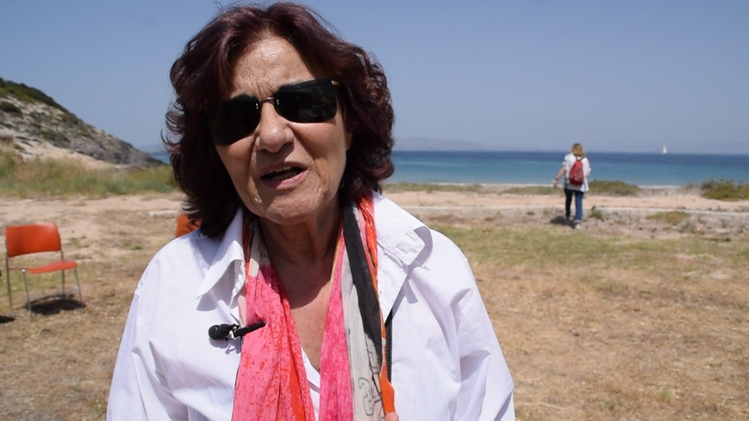
    For the second consecutive year on 1st May a function of commemoration and tribute was organized by the local SYRIZA group of Aegina and held in the naval base at Tourlos, honouring the political prisoners executed during the German occupation and the subsequent civil war. Participating in the function were the Alternate Minister for Social Solidarity Theano Fotiou, the SYRIZA Europarliamentarian Stelios Kouloglou, the SYRIZA national parliamentarians for Piraeus 1st District and for the Islands Thodoros Dritsas and Eleni Stamataki and the SYRIZA parliamentarian for Athens 2nd District Christoforos Papadopoulos.

    On behalf of the SYRIZA chapter in Aegina the municipal councilor Antonis Delis explained the reasons why the function is being held. A text on the history of the day was read by the medical doctor Mr. Giorgos Bogris

    In the course of the function a number of the participants laid wreaths and flowers on the monument. The co-ordinators of the local group Mr. Panagiotis Patsakios laid a wreath and flowers were presented by Mesdames Fotiou and Stamatakis, Messrs Dritsas, Kouloglou and Papadopoulos, the mayor of Aegina Dimitrios Mourtzis and the granddaughter of “Captain Moria” Georgakopoulos.
    The function was also attended by the president of the social organization of the Municipality of Aegina KEDA Mrs. Kaiti Salpea, the Deputy Mayor Panagiotis Marmarinos, the councilor Nektarios Leousis, and numerous citizens.

    Address by the Mayor of Aegina Dimitrios Mourtzis

    I am with you to express my emotion, to condemn those who wish to stigmatize a different ideology, those who since seventy-one years ago when the last execution took place here unfortunately have not realized that in this country we are who we are, we are Greeks, we are Hellenes, we are Greece, without dividing lines, with different viewpoints, with the ideology of mutual respect, an ideology that is the greatest ideal we have within us, within our conscience, and it is not possible for anyone to take this ideology away from us. My hope is that the actions that took place here will never again occur in our country. This day that we are here I wanted all the groupings of the parliament to be here. Whatever mistakes there were, the policies behind them are to be condemned and we should show by our presence that something has changed in this Greece that is struggling to move beyond these narrow confines that have been imposed on us.

    I came here as mayor, with great emotion but also as a Hellene, to say that my presence here is necessary, irrespective of whether I represent, in an honorary capacity, this region. I come here as Dimitrios Mourtzis, to present, along with the condemnation of this behaviour, the message that we must at long last stop what has been plaguing us for so many years. The last execution took place here seventy-one years ago. Seventy-one years passed, unexploited. I address my friends the ministers that I see facing me, my friends of the Greek parliament, all the members of the municipal council, all the people who came here to declare their concern.

    Statements by Theano Fotiou, Thodoris Dritsas and Eleni Stamataki on the commemorative function at Tourlos

    Statements on the function at the monument in Tourlos to the political prisoners executed during the German occupation and the subsequent civil war were made to Aegina Portal after the end of the ceremony by the Alternate Minister for Social Solidarity Theano Fotiou and the SYRIZA parliamentarians for Piraeus 1st District and the Islands Thodoris Dritsas and Eleni Stamataki.

    Theano Fotiou: “It is the first time for me that I am celebrating May Day in this way, honouring the executed activists of the National Resistance, and indeed in Aegina. Truly for me the whole function was serious. It was an opportunity for reflection on exactly what happened. On the one hand let us not forget, on the other let us learn and never ever allow fascism to raise its head again.

    Thodoris Dritsas: “For a second time this year we see this marvellous initiative by the SYRIZA local organization in Aegina to commemorate the activists held in the Aegina prison and then executed at Tourlos in the period between 1940 and 1944 and subsequently 1947 to 1949. Justice, progress, peace, vindication of the struggles of these people gave their lives for the highest ideals. The participation of local government, the mayor and many other representatives of Aegina society is very promising and paves the way for this initiative to be embraced by all the social and political forces of Aegina. It is a worthwhile objective within the prospect of peace, progress and vindication of the struggles of the Greek people.”

    Eleni Stamataki: “For us today is not a day of celebration. It is a day of commemoration and tribute. We remember and honour those who struggled, throughout the world, for equal rights and equal conquests and this is why we are here, on this sacred site where eighteen activists of the National Resistance were executed, surreptitiously and illegally. They are the ones we honour today.

  • Interview with Mikail Böök on DiEM25’s draft nuclear weapons platform

    Aegina, November 2017

    Mikael welcome back to Aegina. You haven’t been here for nine years, since the Capodistrias-Spinelli-Europe seminar in November 2008. Isn’t that right?

    That is right.

    You and I are both members of the pan-European citizens’ movement DiEM25. This week DiEM25 voted to stand in elections throughout Europe. Do you have any comment on that?

    Well actually I hope it will succeed as a pan-European movement. I don’t see how it can have a great success the first time it stands in elections but maybe it can make DiEM25 better known because for instance in Finland it is quite unknown I would say.

    But it was also decided that DiEM25 members don’t have to become involved in electoral campaigning if they don’t wish to. And it was decided to establish more thematic collectives. Four of us have already formed a nuclear disarmament thematic collective – you are a member of course – and we have submitted a draft platform to DiEM25’s co-ordinating collective. Are you happy with the content of our draft anti-nuclear-weapons platform?

    Oh yes. I am quite happy with that, and with the process we had discussing directly before we submitted it. Actually we have only tried to submit it because it has not been in any way formally noted by the councils of DiEM25. I would like to make a short comment on this electioneering first. I am still only an associate member myself of DiEM25, and that is precisely because I felt that DiEM25 has not presented a more comprehensive political view, especially on the place of Europe internationally, in the world. And for me if we speak about democratizing Europe and we hope that the European Union will become a positive factor in the world. The essential thing for me is to denuclearize entirely.

    Right, well we’re going to get onto that. That’s what I wanted to talk about now. There are two elements in our platform that we might like to emphasize. The first was included at your initiative and it is a quote from Altiero Spinelli, one of the key architects of the European Union. “The United States must be prepared to disengage itself militarily and to accept the denuclearisation of Europe.” That’s what you said, and this has been included. Any comment, or shall we go on.

    Well, that is something that really needs comment, but that is something which has been, I would say, forgotten, or rather made into some kind of a taboo. I’ve never heard the present leaders of the European Union make this quote. It’s really a quote from another epoch.

    The other element in our Draft Platform is the final clause of the Saintes Appeal: “Europe must become a totally nuclear-free zone, so as to contribute to total denuclearization of the planet, without waiting for similar action by other countries or continents.” Now you and I both attended the disarmament rally organized by ACDN, Action des Citoyens pour le Désarmement Nucléaire in May 2008 in the French town of Saintes, and we worked together to have that clause included in the Saintes Appeal. A requirement for independent European Nuclear Disarmament. Do you think that this requirement is relevant now, as it was in 2008?

    It certainly is as relevant. Maybe I myself look at it from a little bit different viewpoint because one must recognize that this concept of denuclearization is an extremely complicated process. It is not only a political process. It is even a technical process, which is complicated because of the huge amounts of fissiles and wastes from the nuclear power stations and so forth. To think that Europe will become denuclearized also in the sense of sealing nuclear plants, that will take a long time but certainly I think that the European Union should go in for – we can’t call it unilateral nuclear disarmament…

    Independent.

    Independent, without waiting for global agreement, like the Nuclear Non-Prolferation Treaty.

    Right, we’re going to talk about that now. What do you think our chances are of having this platform, with these demands in it, accepted by the co-ordinating collectives of DiEM25? What do you think our chances are?

    Well, right now at this moment it is autumn. I’m a little bit pessimistic because the reaction to our proposal has been so slow, or even non-existent.

    They have been concerned with the electoral opening at the moment.

    That does not make me very quiet. Obviously because on the other hand we can say that in the general debate nuclear weapons are sort of….. the threat of nuclear war has to some extent again become effectualized.

    Would you agree that the Nuclear Weapons Non Proliferation Treaty has failed and that this makes it more necessary that there should be a European initiative for independent nuclear disarmament? Not waiting for movement from the other nuclear weapons states?

    Yes, certainly. But although the Nuclear Non-Proliferation Treaty has failed, I wouldn’t say that one should just put it in the dustbin. The diplomacy, the efforts of the governments towards nuclear disarmament must go on and the Nuclear Non-Proliferation Treaty also.

    Let’s say a few words about the current deadlock over North Korea and its nuclear weapons. In September the French President – and maybe you can show this to the camera. See this. Show it. – In September the French President Emmanuel Macron called upon the United Nations to react quickly to North Korea’s expansion of its nuclear weapons programme. He also said that the European Union must make a clear and united response.

    Now there was a reply to this from the North Korean official Ri Tok Son, who said: “It is ridiculous to claim that the nuclear weapons of the Democratic Peoples’ Republic of Korea, which are a deterrent against blackmail and threats from the United States, could target Europe. If nuclear weapons are so bad, France should be the first to abandon its nuclear weapons, because it is not under threat from the nuclear weapons of any state.

    Do you think it would be possible for the French President to say anything convincing in response to this challenge from the North Korean official?

    That’s a thing I haven’t given much thought to, so I have no comment ready. I think however that France, as other governments, should also have diplomatic efforts and dialogue with North Korea, however strange the policies of the North Korean state might seem.

    There are historical precedents for bilateral nuclear disarmament agreements, for example between Brazil and Argentina in 1991. Do you think that European citizens should try to persuade France to sign such a bilateral agreement with North Korea? This could be a step towards resolving the present deadlock, couldn’t it? Particularly if North Korea is attached to its nuclear weapons primarily for reasons of prestige, not because it really needs a so-called nuclear deterrent. That is something that was implied a few months back by President Trump’s former advisor Steve Bannon, who said that North Korea could destroy Seoul in half an hour with conventional weapons.

    The later part of your question I didn’t quite get but I would say that I am not at all opposed to the idea that France would sign a separate agreement on non-aggression – a nuclear non-aggression agreement – with North Korea. I am not opposed to that idea. I am opposed to the idea that the European states should be subordinated to American nuclear doctrines.

    A number of key figures in today’s climate change debate, particularly people making proposals for geoengineering as a response to climate change, people such as David Keith, Alan Robock, Ken Caldeira, have a pre-history of involvement with nuclear weapons laboratories. Has it ever occurred to you what great similarities there are between the logic of the Nuclear Weapons Non-proliferation Treaty and the logic of the United Nations Convention on Climate Change? In both cases there is an assertion of inequality. For the Nuclear-Weapons Non-Proliferation Treaty the inequality is between the states possessing nuclear weapons and the states not possessing nuclear weapons. For the United Nations Convention on Climate Change the inequality is between the Industrialized countries that are said to have been mainly responsible for global warming or climate change and the developing countries that are suffering, or will suffer, the worst effects from climate change. In both cases the United Nations takes upon itself the mission of defending the weaker parties, in the interests of promoting nuclear disarmament in the first case, and in the interests of promoting what is called climate justice in the second case.

    Do you think that it is realistic to hope that the United Nations can achieve either nuclear disarmament, or climate justice, through international negotiations?

    The first part of your question that compares the Nuclear Weapons Non-Proliferation Treaty and agreements on climate change – it has not occurred to me to compare them in this way so I have no ready thoughts about that. The second part of your question, which is a really key problem, I think, of the future of mankind. It is generally believed, I think, or at least it is generally said, and held, that the only road is a global agreement between governments. I don’t think so. I think the road is that somebody starts and it is, of course it is extremely complicated because all dimensions of human existence are involved, including the military one, and one should see that to start, to begin, with nuclear disarmament, also signifies implementing, thinking out, a different military strategy, and I think Europe – I think this is something that will happen regionally and Europe could be, or should be, certainly because of its role in world history, taking that initiative, being the first to break with nuclear armaments, to show a way out from that, and not in an aggressive way. I’m also convinced that if France, Germany, Britain, would start with this, or even if a smaller state would get this process running, they would succeed. And the UN agreement on a prohibition on nuclear weapons, which has now been adopted – last July – was started by small states, including Austria and Sweden in Europe.

    The economist Jeffrey Sachs was present at the United Nations when President Trump made his first speech there, which was filled with threats against North Korea. Jeffrey Sachs declared himself to be appalled at the behaviour of President Trump, particularly because of the United States inclination towards starting wars. He says that this inclination towards war is something that can be controlled only from the top, and this makes it terrible when at the top you have a person who talks and acts the way that Donald Trump does. Do you think that Jeffrey Sachs is right when he says that the drive towards war and violence and destruction is something that can be controlled only from the top, and if he is, what is the point of having citizens’ campaigns against nuclear weapons, or against environmental destruction or whatever?

    Well, you could have left out the last part of your question because that sort of begs the question. I don’t agree with Jeffrey Sachs’ point. I don’t think that the leaders of the governments and states are in control. I don’t think that the processes which lead to wars, especially big conflicts, wars in the traditional sense, like the Napoleonic wars or the First and Second World War…. Of course, there are people who start them, and want them. But to believe that we are in control in that sense of the processes is a mistake.

    This hotel that we are in at the moment was the place where at the beginning of this year Yanis Varoufakis spoke to the citizens of Aegina to tell them about DiEM25 and its proposals for Europe. We have made some proposals now to DiEM25 on the subject of nuclear disarmament, and in particular a proposal to be addressed to Mr. Varoufakis’ friend Emmanuel Macron. A proposal for independent European nuclear disarmament, starting from France. Is this a reasonable proposal, and can we hope that it will be accepted or have we already talked about that?

    We have talked about that, of course, because we have made the proposal. Of course we think that it is reasonable. I think that many people believe, like us, that it is reasonable. A quite different matter is whether even DiEM25 will manage to adopt a clear policy or see the future in this perspective. Even in our discussions we found immediately the group of people, which is very big, that believe in nuclear deterrence and believe that the nuclear weapons have saved the world from the big traditional conflicts between governments. So that’s a huge obstacle. We have discussed this very much also.

    Well let’s see now if we can have some commentary from Jean-Marie Matagne from ACDN, Action des Citoyens pour le Désarmement Nucléaire in Saintes in France. We’ll send him what we said and see what he has to say in response.

    Thank you very much Mikail and I hope you enjoy the rest of your stay in Greece.

    Thank you.

    (The interview was taken by Wayne Hall)


  • Catherine Austin Fitts and Yanis Varoufakis

    It is a fantastic compliment for Yanis to receive this accolade from Catherine Austin Fitts. He has received similar compliments from the Saker. If only the admiration were reciprocated. YV may well not know who Catherine Austin Fitts is and how important these words of praise for him are for boosting his credibility in circles where it is not so great, to say the least. She is part of the right-wing that is ahead of the left in many respects. The part of the right that would be capable of the “historic compromise” on the terms of the Left that the Eurocommunists failed to achieve

    Wayne Hall

    “The danger is not that we shall aim too high and miss; the real danger is that we train our eyes on the floor and end up there.” ~Yanis Varoufakis

    By Catherine Austin Fitts

    I often say, “he who archives, writes history.”

    Greek finance minister Yanis Varoufakis kept impeccable records of Greek efforts to negotiate with European bank creditors, the IMF and ECB in 2015. (Proof that freedom fighters can use smart phones to record, not just the NSA) His good faith and technical competency in seeking a win-win negotiation creates a powerful baseline that proves the European Union’s austerity policy is war by financial means.

    Varoufakis assumed that the EU would seek a solution that made it possible for the creditors to be paid from a healthy Greek economy. He learned instead what it is like to face a financial coup d’etat.

    Debt is a weapon. Once debt is fraudulently induced in large amounts, engineered with the help of a compliant elite earning “fees for our friends,” it transfers control to a handful of large banks. Then multinational corporations and private investors can strip the country and pick up assets and acquire market share at prices significantly below market. Policies can be implemented that lower life expectancy and weaken the health and intellectual capacity of a population. In a weakened state, they will submit to the loss of national and individual sovereignty and accept high-tech feudalism.

    This is a vulture dance hidden behind banks and bureaucracies that lie, obfuscate with complex process and give long speeches. Taxpayer money is merely free capital used to strip a country as economic control is transferred to private and corporate investors at windfall prices.

    From 1955 to 1995, Fortune 500 revenues grew at approximately the same rate as the GNP. Subsequent to 1995, after the inclusion of the technology companies in the index and the creation of the World Trade Organization, Fortune 500 revenues grew at more than double the rate of the underlying economy.

    Varoufakis documents what that centralizing corporate tornado looks like when it hits on the ground. It looks like statecraft fronting for criminal enterprise – because that’s what it is. It is a planetary coup d’etat by financial means. It is the privatization of government by the “just do it method.” The price of centralizing the economy is destroying economies until and unless the revenue and income flow through the invaders financial statements.

    The Guardian called Adults in the Room “One of the greatest political memoirs of all time.” Varoufakis makes a compelling case that people who are committed to a human culture and democracy must unite throughout Europe to stop this economic lawlessness. If he succeeds in doing so, the Guardian will be proved right.

    If you read one book on current events this year, it should be Adults in the Room.