Category: English

  • Aegina: celebration of the anniversary of the swearing in of Ioannis Capodistrias 2021

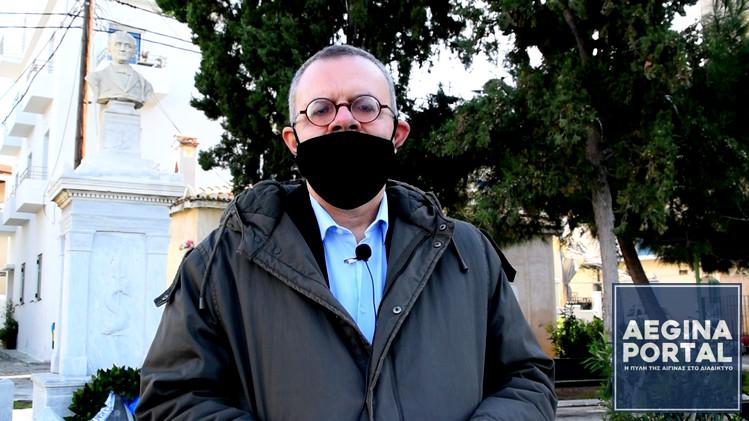
    The president of the 2021 Committee of the Municipality of Aegina, Mr. Manolis Kottakis, speaking today to Aegina Portal, offered a first assessment of the work and activity of the committee. He also mentioned what the committee is programming for the coming

    period.
    https://www.aeginaportal.gr/aftodioikisi/epitropes/29687-o-manolis-kottakis-kanei-ena-proto-apologismo-tis-epitropis-2021-tou-dimou-aiginas-kai-parousiazei-ton-programmatismo-tis-epomenis-periodou.html

    On the occasion of the celebration of the arrival and swearing-in of Ioannis Capodistrias on our island, I want to give a briefing on what the Municipality of Aegina and the local committee for 2021 has done up to now, and what we are planning, bearing in mind that everything remains unsettled because of developments with the pandemic.

    “The Phoenix” on the numismatic programme of the 2021 National Committee.

    The committee started work in July 2020 and between then and now we have succeeded in having the “Phoenix”, the Greek State’s first coin included on the official numismatic programme of the 2021 National Committee. In this way our island attracted publicity through the “Phoenix” also, in all of Greece.

    The Capodistrian buildings on the television channel of the Parliament

    We also managed through the television channel of the Parliament to have an exceptional programme screened with participation from Mrs. Theologidiou, father Emmanuel Giannoulis and Giorgos Bitros, with references to the Capodistrian buildings, and the buildings were presented, for the first time, with the use of drones. The projected scenes are impressive. Anyone who has not seen the programme can find it on the Parliament site and you will see that our Aegina has made an impression there too and finds itself the centre of attention.

    The Committee’s official website now functioning

    We can also announce that in this period the Committee’s official site Aegina First Capital came online, respecting public money because the site operates with a grant from Alpha Bank following a decision by its president Mr. Vassilis Rapanos, whom we now thank, and with the consequence that with the functioning of the site there has been a dramatic increase in visits to the Aegina First Capital link.

    The ramp at the Governor’s House and the exhibition in the Hellenic Parliament

    A few days ago also (said on 24th January 2021) work was completed on the Governor’s House (the first “Maximou”), to which the exhibition in the Hellenic Parliament is to be transferred. Archaeological finds were uncovered during excavation and the ramp constructed by the Education Ministry to make the Governor’s House visitable, is ready. A public thank you for their intervention on this issue to the director of the Prime Minister’s office Grigoris Dimitriadis and to the Minister of Education Niki Kerameos, and indeed to the Minister’s advisor Mrs. Despina Mavri. They showed tangible interest in seeing this particular work completed. It is small but decisive for the reopening and renewed functioning of the Governor’s House.

    Two book publications with important information   

    I must tell you that so far, and with this I conclude the first tentative assessment of our committee and its work, two publications which place Aegina at the centre of their inquiry have been circulated with the support of the committee. The first is the book of the Archbishop of Athens Ieronymos on the subject of Church property. It includes a rare document, a decision from among the first signed by Capodistrias here in Aegina, where it shows that the Ministry of Education and Religion were amalgamated and from that time it was decided that they would go together. This was in Aegina in 1828. It also emerges from the Archbishop’s book, which His Grace was so kind as to send to me, that the Holy Synod was convened in hybrid form for the first time in Aegina. So Aegina was not only Greece’s first capital but it was here in fact that the Holy Synod, and the Church of Greece, were founded.  

    Programming in the coming unsettled period

    It is now time to say a few words about programming, always of course taking into account the unsettled situation because of the pandemic. Owing to the restrictive measures we did not manage, unfortunately, to have the time of the arrival of Capodistrias, 24th, 25th, 26th January, these three days, to be three days of commemorative celebrations which would promote Aegina throughout Greece. But you saw that today in the panegryic of the day the former minister Alekos Papadopoulos also testified in his address that Aegina was Greece’s first capital and we thank him for that public acknowledgement.


    The programming, which as always is tentative, because of developments with the pandemic, provides that now, since the ramp to the Governor’s House has been constructed, the exhibition from the Hellenic Parliament will be transferred here, and we anticipate that it will be in operation in March, with the expectation that we will combine its inauguration with celebration of our national day on 25th March, conditions permitting.    

    Ready for printing the “Aegina of Capodistrias” album. The preface was written by the President of the Parliament Constantinos Tasoulas

    I would also like to announce that the album entitled “The Aegina of Capodistria” is also ready for release. It was edited by the journalist Giannis Provis, with writers Pronoi Theologidou and our fellow citizen Dionysis Kalamakis. A few days ago we received the preface to the album, which the president of the Hellenic Parliament Mr. Constantine Tasoulas did us the honour of writing. The Parliament in fact has undertaken to print the album in 3,000 copies to make available in print the history of Aegina, the arrival of Capodistrias on our island and his contribution here, with confirmation of the documented fact that it is here that the founding acts of the Modern Greek State were brought to fruition.

    The pageant of the arrival of Ioannis Capodistrias in Aegina

    In May, if all goes well, the pageant that we had begun to prepare for performance today, the pageant to celebrate the arrival of Ioannis Capodistrias, will be staged in May. We will be in a position to give further details in the near future. We also have in preparation a major concert to be held at the temple of Aphaia, a surprise concert to be given by a very great Greek composer. I am not permitted to reveal his name, but the concert is programmed. And the functions of celebration, all being well, with everyone’s assistance, will close in September with the results of the student competition on the work of Ioannis Capodistrias.    

    That is the overview. We are struggling in very difficult conditions to organize the celebration. I think that my experience to date indicates from the functioning of the committee, to whose members I extend my thanks, and of course to the mayor of Aegina and the municipal council, that all these functions of celebration must continue after 2021. The history does not finish in 1821. We must continue into these coming years.

    Manolis Kottakis
    https://www.aeginaportal.gr/eidiseis/kathimerina/29686-giannis-zormpas-apodedeigmena-eimaste-i-proti-proteyousa-tou-neou-ellinikoy-kratous-i-dilosi-tou-dimarxou-gia-ton-eortasmo-tis-afiksis-kai-tis-orkomosias-tou-ioanni-kapodistria.html

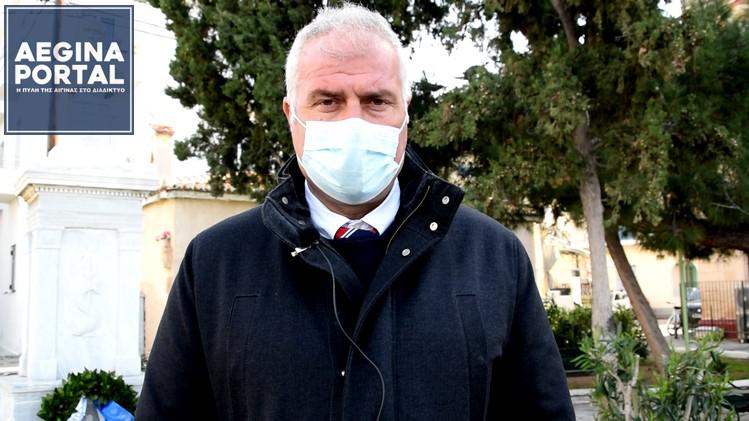
    Giannis Zorbas: “It is a fact that we are the first capital of the modern Greek state.” The mayor’s statement on the celebration of the arrival and swearing in of Ioannis Capodistrias

    “It is a fact that we are the first capital of the modern Greek state” declared the mayor of Aegina Giannis Zorbas after laying the wreath this morning at the Ioannis Capodistrias monument next to the Panagitsa church. And he expressed the hope that next year the celebrations will be able to take place normally.

    “Today we welcomed the former minister Mr. Alekos Papadopoulos, celebrated the mass in our cathedral and a small detachment came here to pay tribute and lay a wreath for the first governor of this country, whose swearing in on 26th January 1828 we celebrate today. Here in Aegina it is historically proven that we are the first capital of the newly formed Greek state. I wish you a good Sunday and from the bottom of my heart hope that next year we will be able to celebrate this event with cultural activities. This event of the swearing in, and that we will once again be living normally” said Mr. Zorbas.

    Commemorative speech from the former minister Alexandros Papadopoulos
     https://www.aeginaportal.gr/eidiseis/omilies/29684-o-panigyrikos-logos-tis-imeras-apo-ton-proin-ypourgo-aleksandro-papadopoulo-2.html

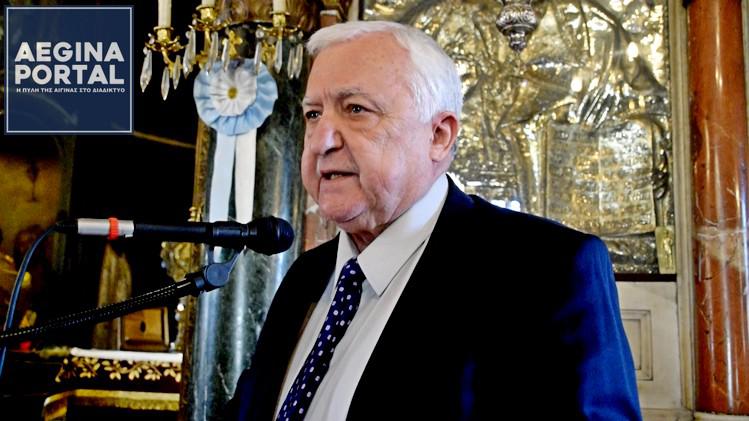
    The commemorative speech of the day was delivered in the Aegina Cathedral at the end of the mass by the former minister Alexandros Papadopoulos. Alexandros Papadopoulos was welcomed on behalf of the Municipality of Aegina, the 2021 Committee of the Municipality of Aegina and Ioannis Capodistrias Cities’ Network by Mr. Manolis Kottakis.


    The text of the commemorative speech


    Ladies and gentelmen,
    Much has been written about the life and the great contribution of Ioannis Capodistrias to our nation. I do not intend to repeat today what has been said at times about the martyred governor, and particularly here on our island, from where there began the creation
    ex nihilo of our newly formed state. You Aeginetans have honoured him, and honour him more than, perhaps, anywhere else in the country. You have been identified with his memory, not only because he made Aegina staging post for the new state, choosing it as the first capital, but above all because the assiduity and the intellectual ardour of the governor liberated from within immense spiritual forces with the power to transform a rude and ruined land into a modern country and instill its exhausted people with the psychic and spiritual strength to stand on its feet, mobilize new energies, find new hope. This echo, this muffled murmur coming from the depth of two centuries is something one feels, distinctly still, as one’s ancestors felt it even more, seeing a man struggling every day almost alone, and achieving so much in the short time he was allowed to live. They trusted this hermit politician and stood by him, this political saint so devoted to his country. The truth is that the death of the governor was followed by a void and the makeshift Greek state he left behind was destined to evolve into a post-Ottoman entity that has been struggling for two centuries to find its national character between East and West.

    The period after his assassination and what directly followed led our great historian Constantine Paparrigopoulos, in total disillusion, to say “Unfortunately the new Greek state killed the Greek nation.” Because he saw its spiritual powers being drained. They were what had kept our people on their feet through four hundred years of subjugation.

    The lack of inclination and belief in the creation of a new state worthy of trust with roots in institutions and rules, was something obvious. Paparrigopoulos saw the Greek people trailing behind their leaders as “the armies of defeat” to cite the phrase used later by K. Karyotakis. He watched as every attempt launched by the Governor to construct firm foundations for education, justice, social welfare, the army, a fiscal and monetary system and, above all, a sense of national dignity collapsed to the point of disappearance.
    It is true that although the country has progressed significantly since then and progress has continued to the present day, it is still going forward only to go back again, with roughneck politicians, fruitless antagonisms, with demagogues,with misleaders. A society without hierarchies, with great cultural and social deficits, with a lack of the necessary common rules, which people obey not out of fear of punishment but out of a sense of self-discipline and the collective good that is characteristic of integrated societies.

    Unfortunately this catastrophic desertion of the spirit and the work of Ioannis Capodistrias and subsequent dismantling of everything he managed to build in this spirit leads us to the definite conclusion that this was the reason that modern Greece was never culturally completed. It was not socially completed.
    The collective vision is something Ioannis Capodistrias struggled for more than any other later politician in this land. Capodistrias’ vision became the vision of his people who sweated and shed blood, unfortunately, for it. His vision was to reconstruct the state foundations of “romiosyni” from its ashes and put it on a sound basis so that it could go forward with co-ordination and standing on its feet bearing the weight of its cultural heritage, a heritage which no other country in the civilized West possesses.

    The basis of the Capodistrias’ foundational and reformist vision was education. On it he built everything mentioned above, which I why I confine myself to mentioning only education so as to diagnose the dimensions of the Governor’s overall inspiration and make the comparisons of the whole subsequent trajectory to this day.

    Capodistrias found education in a state of disintegration and not functioning because of the years of war from 1821 and after. “For the schools buildings are needed, and when I arrived here I found only huts housing a host of starving families.”

    Capodistrias’ ideas on the education of Greeks follow from his convictions. From the most general perspective, note that he himself wrote: “It is an honour, and something sacred, for a child of Hellas to be raised in the knowledge of our holy religion, to be educated in the language of our forefathers and be prepared for higher university studies.”

    It is no accident that a ministry was established “with a secretariat of ecclesiastical and public education” and Nikos Chrysogelos as secretary. He had responsibility for both church issues and educational issues, a cohabitation which continues to this day.
    Capodistrias believed that the people should be educated, otherwise what would prevail would be “the will of the stronger, supported by the ignorance and brutalization of the mass.” The objective could be achieved through a combination of intellectual and manual work and the promotion of vocational education. The aim was to establish at least one school in every village and town. “Henceforth I insist on these three goals, to establish in every community one or more mutual schools, to lay the foundations of formal schools and technical schools, with mutual teaching the chosen method.”
    The mutual teaching method was used from the mid-17th century in England and was perfected in the 18th century in the France of Sarazin. It was so named because under the guidance of the teacher the best students (those in the front rank) were used to teach the other students in the younger classes. Mutual teaching was officially introduced by Ioannis Kokkonis in the time of Capodistrias, who translated (1830) the guide to Sarazin’s peer-to-peer teaching method.

    Capodistrias set up special committees that would “translate and compile elementary books and revise a textbook already translated, contributing to a more uniform and perfect organization of peer-to-peer and formal schools.” He rewarded the best students with scholarships and helped the needy students to continue their studies: “Point out to us those of your students who provide consistently obvious examples of their innate talent and ability and we will invite them to perfect their skills in the model school.”

    Nikolaos Dragoumis said: “He gave every example of this admirable concern in each of the model schools in Greece, striving in every way to promote education and for this reason constantly visiting schools, kindly encouraging teaching, being taught and autographing thank-you letters to youngsters

    He wanted the teachers to have the necessary knowledge to teach, and he exhorted them: “The committee does not want to recommend to the Government a mutual teaching school as competent if it is not expert in grammar and able to explain Aesop, Isocrates and Xenophon in the vernacular . It would be desirable also to be able to explain Homer.”

    He also encouraged the teachers: “Teacher,” he said one day, “you lead the hopes of the homeland”. And he gave them financial help. In order to compensate the teachers properly for the expenses they incurred, wanting to encourage the students’ sense of honour : ” We offer them for free 300 piastres for each of the students admitted to the model school “. According to the report of Nikos Chrysogelos , Secretary of Religious Education and Public Education, the few schools in the struggle had increased in number by 1831 to 121, and there were 9,246 students, of whom 6,718 attended the 75 mutual teaching schools that were in operation during that period in the country.

    The fruit of all these efforts was the establishment of the orphanage in Aegina. The Orphanage operated three mutual schools at the same time. One was named the Eynardio “because it was built and maintained at the expense of Eynard.” There was a great deal in the way of handicrafts in operation (turning, knitting, carpentry, blacksmithing, shoemaking, sewing, typography, bookbinding, lithography, watchmaking, etc.) Music lessons were also taught at the Orphanage, and a choir was formed. When Capodistrias visited the orphanage and saw the progress the students were making in music, he issued an order approving the purchase of 12 violins and a special uniform for the members of the choir “white apron, chemise and blue belt”.

    In addition there was a model school which aimed at educating teachers to staff the mutual schools. Also founded on November 1, 1829, was the Central School, under resolution 97, aimed at educating young people wishing to pursue university studies. After the assassination of Capodistrias, the orphanage and the handicrafts vegetated and faced huge problems, due to the indifference of the state.

    The National Printing Office was also founded in Aegina.

    In Tiryns the Agricultural School was established for the teaching of modern methods of agricultural cultivation and animal husbandry; in Nafplion the Central Military School, in Poros the Ecclesiastical School in the monastery of Zoodochou Pigis in Poros for the education of future clergy, the Commercial School in Ermoupoli by the town’s merchants. Schools were established in Nafplion, Argos, Tripoli, Athens, in Aegina, Poros, Hydra, Galaxidi, Nafpaktos, Methoni, Filiatra, Patras, Kalavrita, Skiathos, Syros, Amorgos and in many other towns and islands. Secondary schools were established which he called “model” or “formal”, while at the same time maintaining the so-called Greek schools. Capodistrias also attached great importance to the education of girls, at a time when the position of women in society was undervalued.

    A girls’ school was in operation in Syros, Tinos and the Aegina Orphanage for the education of females. There was also a coeducational school in Corinth. Capodistrias aspired to the establishment, in due course, of a University, when the necessary financial resources were available, along with the prospective students. As Nikolaos Dragoumis put it: “He did not see primary education as the purpose and this kind of education as education as such, but as an addition to the higher level. The architect built a house for the baby, but a house that was large and luxurious and without foundations was not what the Governor had in mind. He loves, respects and acknowledges higher education and the most noble influence of the ancient writers on the heart and mind. He accepts them because he has studied them, one after the other.”


    He proceeded, at the beginning of 1831, to publish in Aegina a literary, scientific and technological newspaper on a variety of subjects called “AEGINAIA” with the assistance of the National Printing Office, under G. Apostolidis Kosmitis. The main columnist, translator and instigator of the ambitious publishing effort was the indefatigable Ioannis Capodistrias, behind the initials I.K.

    Capodistrias took care not only to establish schools, but also to closely monitor their operations. This also emerges from his letter to the director of the Nafplion mutual school K. Nikitopoulos, in which he wrote: “I rejoiced yesterday to find myself among your students and to see their work. The Government thanks you for your zeal in teaching 250 students and promoting their performance, not neglecting your patriotism in choosing to proceed in the face of complete deprivation of the necessary facilities”.

    The conclusion, ladies and gentlemen,

    Today, on the two hundredth anniversary of 1821, massive high walls have been built around us. We are in contemplation, with sorrow and shame and are called upon to be thoughtful, putting aside our despair. Living through a remarkable decline in values and institutions, locked away from the world, ’21 challenges us to tear down the walls of our stagnation, compare then and now and consider what is to come next.

    Without that “next” ’21 is of no value. It is not an occasion for pageantry and populism. It is the impulse that must waken us from the sleep of Lethe.

    Creatively combining our tradition with a necessary modernization, our age is called to bring forth a new type of leadership, from people of the church and people of the enlightenment, to inspire our people and continue the work and vision of Capodistrias from where it was suddenly and violently interrupted.

    Only then will we be able to raise our heads, to think, to feel and to embrace our collective concern for a credible state inside and outside the country, which we so much need. Only then will we be able to raise our heads, to think, to feel and to believe in our collective passion for a credible state inside and outside the country, which we so intensely need. It is important to extract ourselves as soon as possible from the grip of this situation, not with wish lists, with consolation and with constantly buying of political time. The country must now begin to disengage from the state of spiritual stagnation, institutional anaemia, productive dessication in which we have found ourselves. Let us begin to discern the looming geopolitical dangers.

    To understand that today in our country, elites drained of credibility are in command and that our society is in a constant state of enslavement to disintegrative populism. The younger generations of politicians have been poisoned by the sickness of electronic communication and image making. Although they strive to win the war of impressions, they lose the real confrontation.

    In contrast, the Capodistrias of duty, philanthropy and faith, defined by a goal, won the cases to the extent that the relentless reality of his time left that possibility open, because he was a fighter for the great cause of the Nation and not to confirm his already confirmed self.

    Today he leaves us a heavy legacy and a challenge and the opportunity for Greeks to return to the spirit of this great national patriot.

    I am sure that the Celebration Committee will hold elegant and dignified events. However, they are not enough to revive the creative spirit of Capodistrias for a modern and sustainable state and for our people to orient themselves and gain confidence, in order to stimulate a new national decisiveness during this century.

    It will be a pity for the celebration of regeneration, as a starting point for a great conceptual leap forward but also as something deeply political…..to be lost, and I am afraid that this is going to happen.


    We must not miss the historic opportunity to cultivate in our people a new spirit of expectations and responsibilities, in order to take control of its future. Empty grandiosity is not the way to conceptualize the future or build hope.
    The country’s political, social and the scholastic powers must find new starting points that will lead to a new phase in history. This requires a spiritual break with what has reduced life to its own measure and prevented the country from being secured with values of another quality.

    Our generations did indeed contribute to the country’s material recovery, but robust intellectual foundations to support coming generations were left, unfortunately, depleted and weak.

    The result is that fear is instilled in young people. They feel that they are living in an age of atomized consciousness and a nihilistic sense of inevitability impels them towards other societies.

    What is needed today is a resounding call to those who want to align themselves around a contemporary national discourse. They do not need to work hard to invent it. It exists and awaits our recognition.

    It is nothing other than what was communicated by the Governor here on this island and is waiting for us to seize the opportunity for a new emanation of rebirth that will seal the new Hellenic day, in the light of an inspired realism. With the creation at last of a modern powerful state as envisioned by the insufficiently valued leader Ioannis Capodistrias.

    Thank you

  • The Great Reset

    https://www.youtube.com/watch?v=JQulGSF18OM

    It’s not only a great reset. It’s a great deception. Replacing mum and dad’s small businesses and private enterprises with big tech and big business. Democracy and free enterprise go out the window. Totalitarian government control slides in through the back door.

    The Great Reset explained in five minutes.

    Those behind this scheme are adamant that there can’t be and never will be a return to normal, that life will never again be what it was prior to COVID. That is why they constantly talk about “the new normal”.

    Is this what our future will look like?

    The World Economic Forum meets every January in Davos. You’ll have heard of the expression “Davos Man”. It refers to all the zillionaires and pop stars and popes and princes and politicians who meet every year to map out our futures. This year’s Davos is very very different to all the previous ones. The World Economic Forum, along with the United Nations along with the International Monetary Fund and along with any number of prominent globalist organizations and powerful individuals, including Prince Charles, together have jointly promised that the 2021 World Economic Forum will be used to introduce, via a vast network of connected big tech corporations, online activist movements and compliant local and national governments something THEY call the Great Reset. This isn’t some after dark conspiracy theory. It is a global commitment they have made to use the panic and fear generated by the coronavirus as a means to reshape all our economies and laws and move to a new form of capitalism that focuses on net zero emissions. You might think this is a great thing. You might think this is a terrible thing. If implemented successfully, the Great Reset will undeniably and deliberately have extreme and possibly dire repercussions for every single one of your constituents. Already the great reset is being widely advertised on posters and in ads across the UK and Europe, and no doubt will be here before too long.

    “You’ll own nothing and you’ll be happy” is just one of their marketing slogans. The plan involves replacing shareholders of big companies with stakeholders, who happen to be left-wing bureaucrats and climate change zealots, replacing mum-and-dad small businesses with Big Tech and Big Business. Mrs Kafoops’ share portfolio is out. Greta Thunberg and zero emissions are in. Democracy and free enterprise go out the window. Totalitarian government control slides in through the back door. But remember, it’s not only a great reset. It’s a great deception, because in order to get everyday people to surrender any of the rights and freedoms we currently take for granted, the repeatedly stated aim of these is to deliberately use COVID as an excuse to use all the political and authoritarian “tools”, as Prince Charles puts it, that are currently being used around the world to eradicate the virus, such as lockdowns, exclusion zones, forced closure of businesses, heavy fines, making protesting illegal, and so on, but now to eradicate carbon emissions. Those behind this scheme are adamant that there can’t be and never will be, a return to normal, that life will never again be what it was prior to COVID. That is why they constantly talk about “the new normal”.

    This is not me saying this, this is them saying it, the people with the power, and the means, and the obsessional desire to do it. And they keep telling us again and again precisely what they have in store. “Now is the historical moment, the time, not only to fight the virus but to shape the system.” “We have a unique and rapidly shrinking window of opportunity to learn lessons and set ourselves on a more sustainable path. It is an opportunity we’ve never had before and may never have again, so we must use all the levers we have at our disposal, knowing that each and every one of us has a vital role to play.” “The Great Reset is a welcome recognition that this human tragedy must be a wake-up call. It is imperative that we re-imagine, re-build, redesign, re-invigorate and rebalance our world, rebalancing investment, harnessing science and technology and advancing the transition to net-zero emissions. All elements of the Great Reset are fundamental to building the future we need.” And if it’s still not clear, the book written by World Economic Forum boss Klaus Schwab himself, setting out precisely how the most powerful forces in the world are lining up to use the COVID19 crisis as a pretext for introducing a new climate-change focused one-world economy that will strip away property rights and basic democratic rights. They are not hiding this stuff. They are shouting it from the rooftops. The World Economic Forum boasts on its website that the only acceptable response to the COVID crisis is to pursue a great reset of our economies, our politics and our societies.

    Postscript

    The Aegina Independent Citizens’ Group has two web pages:

    a) Be the change

    b) Aegina Independent Citizens‘ Group

    Also, for those who read English there is the good South-African website PANDA Conservative from the aesthetic viewpoint, it avoids the polarization and hysteria that predominate almost everywhere, without falling victim to “respectable” disinformation.

    Another English-language contribution recommended: “Catastrophe is all around us”.

    W. Hall

  • The Screen New Deal

    SOURCE: Avgi (Greek)

    A few months ago the Green New Deal was the new central and highly urgent demand on the political agenda, with the consequences of climate change expanding in tension and environmental costs.

    MODUS OPERANDI…

    …a column on the way things are operating

    Dora Kotsaka

    A few months ago the Green New Deal was the new central and highly urgent demand on the political agenda, with the consequences of climate change expanding in tension and environmental costs. It had concentrated very broad political alliances, it had been documented scientifically and elaborated in public relations terms to a level where as a demand it was considered “politically mature”. A great amount of public funding is required for a Green New Deal and for that reason it is a political gamble that meets with intense reactions – particularly in countries like the USA where a broad section of the population is sceptical of the very existence of climate change. The state coffers are limited in their capacity and the all-powerful corporate and other lobbies throw all their resources into the arena for the sake of diverting the flow of public monies towards reinforcement of their own vested interests.

    After the pandemic it seems there was a change in the balance of forces. Digital technologies emerged as saviors of humanity as they inserted themselves into every aspect of everyday life. From telework and education to recreation and personal life it is now no easy task to find a sector of human activity in which some corporate digital platform is not implicated – with oligopolic status in most cases. Given all this, the negotiating power of the technological colossi has grown even further. And it was already huge.

    Obviously the energy transition and the Green New Deal are not included in the agenda which the latter are tirelessly and systematically promoting. The consequences of the pandemic are today paving the way for discussion of a Screen New Deal and the choice of the term is exceptionally apt, because it is a development that is transforming the modus operandi of the economic model. Everything has been moving very fast lately. The Australian government has concluded a contract with Amazon for storage of data from the controversial Corona virus contact tracking app.1 The Canadian government has signed a contract with Amazon for delivery of medical equipment, prompting questions as to why this facility could not be provided by the public postal service.2  New York announced the city’s adaptation to the post-Covid reality, with emphasis on the steady integration of technology into every aspect of life in the polity and priority for Eurozone-related tasks and the provision of digital services in health and education. Indicatively, in May collaboration with the Bill & Melinda Gates Foundation was finalized “for development of smarter education systems”. 3 Citing B. Gates as a visionary, the Governor of New York asserted that “the pandemic created a moment in history in which we were truly able to benefit from the ideas of Gates… All these buildings, all these classes – why? with all the technology we possess?” he wondered.

    Naomi Klein, the author and journalist who through her work exposed the operations of the “Shock Doctrine” to very wide audiences, argues that it took a little time for the picture to be clarified but something that seems to be a unifying dogma for the pandemic shock is beginning to emerge and is much more hi-tech that anything seen with previous disasters.4  Klein designates as the “Screen New Deal” this future that is currently being implemented and notes that a prerequisite for it was utilization of the weeks of physical isolation – not as a painful necessity for the sake of saving lives but as a real-life laboratory for the purpose of instituting a permanent and highly profitable future without physical contact.

    The “Chinese” project

    The mission of the United States’ National Security Commission on Artificial Intelligence (NSCAI) is to advise Congress on questions related to “upgrading of artificial intelligence, machine learning and associated technologies”.5  In the course of the last year it has clearly identified the extremely urgent problem that has arisen in consequence of Chinese technology companies acquiring the ability to bypass the regulatory restrictions applying for workers’ rights or respect for privacy.6 The protracted crisis in technologies for surveillance of citizens has resulted in an undeniable supremacy in a host of fields including medical prognosis with the use of artificial intelligence, driverless cars, digital infrastuctures, “smart cities” and electronic commerce.7  Last November the NSCAI published a report to Congress in which it was asserted that mass surveillance is the crucial application for basic instruction of artificial intelligence.8  “We are participants in strategic competition. Artificial intelligence will be at the epicenter. The future of our national security and economic is at stake”, they note.

    The centerpiece of the argument – in presentations to policy makers or in articles and interviews for public consumption – boiled down to the Chinese threat. The assertion is that American dominance of the global economy has been on a knife-edge since the moment that the Chinese government has become willing to spend unlimited amounts of public money for the sake of creating the required infrastructures of high-tech surveillance, while at the same time allowing Chinese technology companies such as Alibaba, Baidu and Huawei to reap the for commercial applications. But more than anything else the NSCAI notes China’s willingness to make public-private partnerships in the field of mass surveillance and data collection the basis of its competitive advantage.

    A further ingredient in the above formula is provided by the revolving door between state functions and executive management in the technological giants. Indicatively, the President of NSCIA Eric Schmidt, who occupies the same position on the Defense Innovation Board, the US defense sector’s consultative body for the expanding use of artificial intelligence in the armed forces, previously served as CEO of Google.9  J. Marcuse, executive director of the USA’s Defense Innovation Board announced in May that he was resigning from this position so as to undertake full-time employment with Google as head of public sector strategy and innovation globally.10  The basic objective of these two committees is exponential increase in government funding for research on artificial intelligence and technological infrastructures, something which presupposes investments which will be of direct benefit to companies in which not only Schmidt but also other members of the two committees maintain substantial shareholding. All of these committees are staffed by executives of the most powerful technology companies such as Oracle, Amazon, Microsoft, Facebook, Google. Naturally their vested interests rarely include just their salaries.

    In the case of the President of NSCAI, it is well-known that he owns shares worth more than 5.3 billion dollars in Alphabet (the parent company of Google) and that at the end of February – when the lock down in China had already shown the dynamic of the situation – he was ringing the alarm bells with calls for “unlimited partnerships between government and industry” and a deluge of public money: 11

    “Artificial intelligence will open new horizons for all sectors from biotechnology to banking services and moreover represents a priority for defense of the country…. If matters keep evolving at the present pace, overall Chinese investments in research and development is expected within ten years to overtake those of the USA. This is about the same time as is needed for their economy to do the same. If this situation does not change, around 2030 we will be competing with a country that has a larger economy, more investment in research and technology, better research, more wide-ranging utilization of new technologies and more powerful digital infrastructures. Literally, the Chinese are competing with a view to becoming global leaders in innovation, and the USA is not playing to win.”

    “And after that came the bees”: utilization of the pandemic as second chance after September 11

    In the months that followed everything that had been regarded as dubious demands became a reality. Massive public investment and research in and high-tech infrastructures, a plethora of public-private partnerships in the field of artificial intelligence and relaxation of a great number of regulations for protection of privacy and security. All the above creates a new opportunity for restructuring of the relevant regulatory landscape worthy of comparison with 11th September, when the transformation of US policies on respect for privacy and protection of personal data was encapsulated in the mass surveillance program Total Information Awareness (TIA) in collaboration with the technological colossi. And if we learned something in the years that followed, it is that changes of that kind that are made in emergency periods are anything but emergency solutions. They come to stay.

    11th September completely transformed the landscape when it came to management of personal data. The legislators in Washington had started to become uneasy about the personal data that had been concentrated in the hands of private companies on the internet, which offered free services in surveillance and recording of users’ activities. Indeed on 10th September 2001, one day before the attack on the twin towers a discussion was on the agenda for Congress which many thought would lead to institution of strict rules and abolition of the facilities for surveillance and recording of the activities of internet users. Within the space of a day everything changed.

    The 2020 health crisis offered an opportunity for the next leap forward in the project. Everywhere that lock down was imposed there was a dramatic increase in internet activity. In January the speed of the internet connection in Hubei province, China, was reduced by half. On the global level the use of search engines increased by 25%-30%. There was a sudden increase in demand for services such as contact tracking, location data, face recognition, instruments such as thermometers devices for measuring distance between employees. Infrastructures required upgrading. By the end of April more money had been spent in data centers than in all of 2019. In order to cope with demand Amazon and Microsoft rapidly opened fifty new and very large data processing centers.

    In this new context, with renewed vision and self-confidence, the President of NSCAI changed the tone in which he addressed his compatriots, summoning them to imagine how life would be without Amazon12 : “Companies like Amazon know how to supply and distribute efficiently. We will be required to provide services and advice to government authorities deficient in technological systems and know–how. We must speed up the tempo in distance learning, which today is being implemented on a scale that we have never before had the opportunity to try. Through the internet we avoid proximity, enabling children to receive instructions from the best teachers, irrespective of where they happen to reside…. People should be more or less grateful to those companies that have the capital and make the investment necessary for developing the tools we are using today and which are able to help us.”

    In recent years ever intenser anxieties and ever more vehement objections have been expressed over the model of “surveillance capitalism”. But this climate of suspicion is a thing of the distant past, as long ago as……….February. Today many of these firmly documented anxieties have been washed away by the wave of panic. Against a backdrop of mass deaths we are being offered dubious promises that these technologies are the only possible way to protect ourselves from the pandemic and keep ourselves and our loved ones safe. At the heart of this vision is a seamless coalition of the American government and the giants of Silicon Valley. The public schools, the hospitals, the private clinics, the police, the armed forces, are outsourcing a whole host of their basic functions, at high cost, to private technology companies.

    It would be useful to remember that until very recently public reaction against these corporate practices was rapidly intensifying. American presidential candidates were openly discussing the break–up of the colossal technological companies13, Amazon was forced to abandon its plans for establishing itself in New York after powerful negative reaction from residents. Google’s plans in Toronto were cancelled14 and its employees refused to work on creating technologies for surveillance with military application.15 In brief, democracy and the inconvenient processes of public accountability in planning crucial institutions and public spaces seems to be the last major obstacle to Silicon Valley’s vision. Amid the disarray of the pandemic the opportunity is created for these companies to acquire as much power as their Chinese rivals, who are able to function without the burden of labor regulations and political rights.

    Obviously technology will be a key sector for the protection of public health in the immediate future. Nevertheless, as N. Klein never tires of repeating in her public appearances these days, the problem that arises in periods of collective shock is that decision-making takes place in the absence of public dialogue. The question we are called on to answer has to do with whether this technology will be subject to democratic authority and public control or will proceed in a delirium in a perennial state of emergency. These questions cannot be ignored because they are linked to our future as it will take shape in the coming decades. If we really recognize how crucial digital connectedness is in periods of crisis, should we leave these networks and our data in the hands of private players like Google, Amazon or Apple, who operate under the sole constraint of their obligation to make their shareholders and managerial cadres steadily richer? If public funding is climbing to such heights should the public sector not have ownership and control of the resulting product? If the internet is important for our survival should we not manage it as a non–profit service of public benefit?

    1 https://au.finance.yahoo.com/news/govts-coronavirus-app-sends-data-to-amazon-012946916.html

    2 https://www.reuters.com/article/us-health-cornavirus-canada-amazon/canada-signs-agreement-with-amazon-canada-to-manage-distribution-of-medical-equipment-idUSKBN21L2MO

    3 https://www.washingtonpost.com/education/2020/05/06/cuomo-questions-why-school-buildings-still-exist-says-new-york-will-work-with-bill-gates-reimagine-education/

    4https://www.democracynow.org/2020/5/13/naomi_klein_coronavirus_tech_privacy_surveillance

    5 https://www.nscai.gov/home

    6 https://drive.google.com/file/d/1wkPh8Gb5drBrKBg6OhGu5oNaTEERbKss/view, page 18

    7 https://epic.org/foia/epic–v–ai–commission/EPIC-19-09-11-NSCAI–FOIA-20200331-3rd–Production–pt9.pdf

    8 https://epic.org/foia/epic–v–ai–commission/AI–Commission–Interim–Report–Nov-2019.pdf

    9 https://www.nytimes.com/2020/02/27/opinion/eric–schmidt–ai–china.html

    10 https://cdn.defenseone.com/a/defenseone/interstitial.html?v=9.22.1&rf=https%3A%2F%2Fwww.defenseone.com%2Ftechnology%2F2020%2F05%2Fdefense–innovation–board–director–moves–google%2F165086%2F

    11 https://www.nytimes.com/2020/02/27/opinion/eric–schmidt–ai–china.html

    12 https://www.wsj.com/articles/a–real–digital–infrastructure–at–last-11585313825

    13 https://www.newyorker.com/business/currency/how–elizabeth–warren–came–up–with–a–plan–to–break–up–big–tech

    14 https://www.theguardian.com/cities/2019/oct/31/google–sidewalk–labs–toronto–neighbourhood–scale–back

    15 https://www.washingtonpost.com/news/the–switch/wp/2018/06/01/google–to–drop–pentagon–ai–contract–after–employees–called–it–the–business–of–war/

  • Behavioral Re-Education Camps — School District Produces Video of What a Return to School Looks Like

    SOURCE: activistpost.com

    The debate about opening schools in the fall is heating up, and sadly, it has already become a partisan issue. Liberals have taken the stance that it is not safe to re-open schools, while blasting conservatives who seem to really want schools to reopen.

    Whatever side you’re on in this conversation, if schools do re-open, kids will be subjected to an insane regimen of new distancing and safety measures. In fact, it won’t look like school much at all, but more like a behavioral re-education camp.

    Fullerton School District near Anaheim California recently produced a promotional video for parents, demonstrating what the ‘new normal’ will look like for school kids. And while this is, of course, just one school district, still images from the production offer a fair glimpse of what it would take to reopen schools during a pandemic.

    FULL ARTICLE

  • The blight of localism over 1821 – the case of Aegina

    by George Kyriakou

    What do we say to the following article by George Kyriakou in Aegina? (my translation) In the past I have supported Aegina’s claims to recognition, specifically as the site of the swearing-in of Capodistrias on 26th January 1828 and the creation of the modern Greek state. The date of 26th January corresponds to the date of Australia’s controversial national day and as someone born in Australia I was impressed by this coincidence. In fact it was even the inspiration for a function in Athens on 26th January 2019 in honour of Julian Assange. But George Kyriakou’s perspective, which is supported by the historian Panagiotis Paspaliaris (admittedly a Naupliot but also a person with a respect for historical fact) has won my consent, particularly given its joint support from people with such different politics as Kyriakou and Paspaliaris.

    W.H.

    On 11th May 2020 at an online meeting of Aegina’s Municipal Council an announcement was issued nominating the membership of the Municipality of Aegina’s Co-ordinating Committee for participating in the celebration of the bicentenary of Greece’s 1821 Revolution. (1). The decision was unanimous and approved by the members of the Committee. But as early as January “the question of co-ordinating the activity and the events for Aegina’s participation in the programme of the ‘Greece 2021’ Committee” for celebrating the passage of 200 years since the 1821 Revolution had been discussed in the Aegina Municipal Council, with some preliminary statements, amid proposals for the form the celebration should take and the way this could be promoted to the “Greece 2021” Committee. (2). In June the president of the Aegina committee resigned for reasons unknown(3). A few days ago the new president of the committee, the well-known Aeginetan journalist Manolis Kottakis, assumed the committee presidency with declarations such as “everything started from here, everything started from Aegina, our first capital” (4). In the meantime interventions from the former mayor (5)(6), from the regional councillor and former deputy prefect for the Islands (7) not to mention a protest memorandum from Sakkiotis to the municipal authority-Metropolis of Hydra, Spetses and Aegina (8), were actions aimed at projecting Aegina as the first capital of the Greek state. For whose benefit?

    For a start, the constituted committee itself has not elaborated or mentioned principles, positions or objectives, a necessary terrain of reference for evaluating the Revolution of 1821 and its meaning today, but the Municipal Council has shown an inclination to co-ordinate with the committee officially appointed by the Government. And while there have been unbelievable provocations from Prime Minister Mitsotakis, who declared on 25th March that “two hundred years ago” Greeks brought into being a nation” and from Gianna Angelopoulou and the committee logo featuring a scarf (which with a little goodwill can be construed as a 2 next to a 1) and even more so from members of the Government-appointed committee who ridiculed the memory of fighters of 1821, of Capodistrias; and while there have been the resignation of an academic from the official committee for reasons of self-respect , and provocations from the stance of members of the official committee declaring that “Greeks did not feel oppressed by the Ottoman Empire” and while we face the provocative prospect of conversion of Agia Sophia in Constantinople – which was the unifying symbol of the revolutionary struggles – into a mosque by the Islamo-fascist Turkish regime….the 2021 committee on our island was bursting with pride that “everything started from here, everything started from Aegina, the first capital”, to quote the words of the Aegina journalist Manolis Kottakis. He himself indicated a desire for agreement with Athens mayor Bakogiannis for joint celebrations between the “first capital and the final capital”, sidelining the previous capital because in Aegina the word “Nauplion” is required to be more or less taboo. The priest Father Manolis Giannoulis, historian of Aegina, literally saved the day, explaining at the side of the committee president the meaning of unity: “it is not a celebration that concerns one municipality. It is a celebration that has to do with the total endeavour of Hellenism to achieve a State. Which is why because a State had not been founded one cannot speak of capitals. Pardon me on this point but it was a State under construction. … So let’s forget this first and second (capital)…” (9). With this brilliant and valuable exception once again the people of our local elite, along with others who spend a part of their lives in Aegina, instead of projecting some positions of principle and goals for assessment of the Revolution of 1821, prefer to utilize the easy solution of the temporary housing of Capodistrias’ government, reinvigorating the surviving localism. Another tourist product for the summer of 2021?

    But Aegina, like all other Greek localities, made its own contribution to the Revolution of 1821. People who put their very lives, their property, their ships, at the disposal of the Revolution, participated in battles on land and at sea for the liberation of Greece. Aegina hosted a great number of refugees from the disasters at Psara and Chios, and later in the orphanage and the teacher training college took charge of orphans who were learning reading, writing and practical skills but also of young people who would staff the schools of liberated Greece.

    Aegina is not the first capital of the modern Greek state as is maintained by the official authorities of our island. The first capital of the modern Greek state is Nauplion. Constantinople was the place the enslaved Greeks perennially yearned for. Athens emerged as the administrative option of the foreign factor for dismissing every idea that targeted the liberation of Constantinople and all parts of Greece.

    A necessary historical note on the question of the first capital of the Greek state

    The question of the first capital of the Greek state being in Aegina is something that has been widely “dealt with” in recent years. The first capital of the Greek state has been certified as our island by its official authorities. This has been done without any organization of a conference of national significance or any process of national character. A whole range of political figures in Aegina and Attica (because they have no votes to lose from Nauplion or Corinth), well-known artists, academics, scholars and scientists who spend some of the time in Aegina and personalities from the entirety of the local political system have spoken: the first capital of the modern Greek state is Aegina. It is written everywhere, at all the public serves, on envelopes, on water bills, at every opportunity to elevate localism as the pride of the local elite and present it as a placebo to its voters. The former mayor of Aegina S. Sakkiotis responds characteristically to questions from the newspaper “Ta Nea”.

    -There has always been contention between a number of Greek cities over Ioannis Capodistrias. What claims does Aegina have over him?

    -We are given this right by History. Capodistrias disembarked here. It was here that he laid the foundations of the modern Greek and it was from here that for a year and a half he put Greece on its feet.

    -Have you had supporters in the undertaking to secure national recognition of the anniversary of the swearing-in of Capodistrias as the first governor of Greece, in a local celebration?

    -There can be no questioning of the fact that it was here that the first government of the modern Greek state was sworn in. Accordingly, all scholars and all conferences on Capodistrias who acknowledge the historical reality are our supporters.

    But there are corresponding truths for Corinth. In the speech by the mayor of Corinth in the celebrations for the anniversary of the First National Assembly at Epidaurus in 1822 he said among other things the following: “Today Corinth celebrates the anniversary of the declaration of Corinth as first capital of modern Greece, something not widely known by many”. University academics and other personages of the area lend vociferous assent and for good reasons because of the following well-known facts:

    The institution of the national flag “Land and Sea”. Decree 540 of 15.03.1822 following the decision of the First National Assembly of 1st January 1822.

    The convening of the first Holy Synod

    The establishment of the first state hospital in Corinth

    The founding of the first mint

    The recruitment and organization of the regular army and battalion of Philhellenes (law 11/23-4-1822

    These other points are also mentioned:

    1. Symbolic, because occupation of Acrocorinth was an event of great importance for the revolutionaries.

    2. Geographic. Corinth was situated in a key position, between two important ports: Lechaio and Kechries.

    3. Economic, because its geographic position made Corinth the centre for noteworthy economic activity.

    4. Administrative, because it was the connecting link between the Peloponnese and Roumeli.

    5. Military, because it was of strategic importance and possessed an impregnable fortress, Acrocorinth.

    6. Historic, because it was one of the most important Greek cities of antiquity.

    7. Religious, being inseparably linked to the Christian faith of the Hellenes, visited by the Apostle Paul, who addressed epistles to the Corinthians.

    But Nauplion enjoyed preference as the seat of the still internationally unrecognized national government following civil strife which led to weakening of the polity and the disaster of Turkish restoration under Ibrahim. One day before the termination of its proceedings, that is on 4th May 1827, the National Assembly through its Resolution XVIII nominated Nauplion as seat of the government and of the parliament. The proceedings were terminated on 5th May, with the signing of the relevant resolutions. But confronted there by the familiar civil disturbances and blockaded in the Bourtzi fortress, the Provisional Administration with the consent of the Parliament resolved through Resolution No. 1 and Preliminary Decree 32 to transfer the seat of government to Aegina, to which location they themselves then moved for the reception of Ioannis Capodistrias, who in turn specified in his correspondence with Philhellenes that “all material and moral assistance should be conveyed to Aegina“. It is obvious that Aegina was a temporary solution in the face of the tragic events of civil war. In any case, as soon as the situation normalized, the Governor moved his headquarters to Nauplio in January 1828, about a year after his arrival in Aegina. “Aegina was abandoned. The houses that they had built fell into ruin. The city became a village again” writes E. Abou in his book “The Greece of Othon”, Tolidis Brothers editions, 1982.

    When on 3rd February 1830 the protocol of Greek independence (Spercheios-Acheloos) was signed by England, France and Russia, Nauplion was the capital of Greece. Both Poros, as seat of the Provisional Administration for a brief period and Aegina, from which Ioannis Capodistrias governed for a year, were temporary in their function. Later Athens, as destination of the romantic Bavarians and the dynasty which governed Greece after the assassination of Ioannis Capodistrias, ratified the one-sided relationship of Greece with its ancient history, subtracting the continuity of Byzantium. It was a symbolic and political way to divert attention from the central idea of liberating Constantinople, the symbol of Byzantium, at the same time appeasing the archaeolatric zeal of the European despotism that installed itself as manager of Greek continuity. So, without Byantium there would be neither a national idea nor challenge to the geopolitical plans of the rulers. So from an early stage history has been an object for manipulation, serving the geopolitical ambitions of the world’s hegemons.

    It is no accident that the Philiki Etaireia chose Constantinople as the key site for the uprising of the Hellenes, which included arrest of the Sultan following a surprise attack launched by the crews of the ships. And indeed, in accordance with the “Great Plan”, or the “Partial Plan”, devised by the Kefalonian D. Eumorfopoulos, he himself, in collaboration with the head of the crews of the Turkish fleet, the Hydriot captain Gioustos, master of the Turkish flagship , would bring 400 sailors into the fleet, some of which would be set on fire, and the rest brought into the revolution. Many parts of the capital would be torched and an attempt would be made to arrest the Sultan himself. Philemon writes in this connection: “…All agreed on one point only, that the first explosion should be in Constantinople, half opening the prospect of success in the war through setting on fire of the enemy fleet in its naval bases and eradication of the sultan and the grandees without them knowing of the fires that had been set. Ypsilantis worked on this personally up until the time of his threatened resignation”.

    It is obvious that since the fall of Constantinople, this city came first in the estimation of Greeks. Countless narratives in songs, references laments, brochures, extol the city’s importance as a symbol of Hellenism and Orthodoxy and perennial focus of the Great Idea of liberation of the Greeks. Rigas’ project the “Hellenic Politeia”, a political idea embracing the liberation of all the peoples (including the Turks) of the Balkans and Asia Minor and expressed symbolically by the cross and the club of Heracles (a synthesis of ancient Greece and Byzantium) incorporated the Byzantine state of the era of the Greek renaissance and began to contract under the influence of Western colonialism and the expansionism of the East. So there is nothing surprising about the Philiki Etaireia elaborating plans for beginning the Revolution in Constantinople.

    Today celebration of the anniversary in Aegina, but also in other places where localist tendencies predominate, risks adulteration of historical memory, such that the symbol of every place comes to be seen as being of primary importance for liberation of the nation. So it would be wise for a proper orientation to be adopted by our island for celebrating the rebirth of 1821 and at the same time highlighting the small or great contribution of our particular place to that end. Any other orientation would be in bad faith, for flattering and consoling in an unhistorical way local communities that are being put to the test by an unprecedented and many-faceted crisis. It could only further feed the complacency of local elites who have made localism into an ideological shield. For their own advantage, not for the good of their communities.

    (1) https://www.aeginaportal.gr/eidiseis/kathimerina/28009-ta-meli-tis-syntonistikis-epitropis-tou-dimou-aiginas-gia-ton-eortasmo-ton-diakosion-xronon-apo-tin-elliniki-epanastasi-tou-1821.html

    (2) https://www.aeginaportal.gr/aftodioikisi/themata/27175-i-platforma-gia-tin-ypovoli-protaseon-pou-afora-tin-epitropi-ellada-2021.html

    (3) https://www.aeginaportal.gr/aftodioikisi/epitropes/28215-paraitithike-o-k-giorgos-tsatiris-apo-tin-epitropi-tou-dimou-aiginas-gia-ton-eortasmo-ton-diakosion-xronon-apo-tin-elliniki-epanastasi-tou-1821.html

    (4) https://www.aeginaportal.gr/eidiseis/kathimerina/28391-ola-arxisan-apo-edo-ola-arxisan-apo-tin-aigina-tin-proti-proteyousa-o-manolis-kottakis-parousiazei-tous-stoxous-tis-epitropis-gia-ton-eortasmo-ton-200-xronon-apo-tin-elliniki-epanastasi.html

    (5) https://www.aeginaportal.gr/ekpompes/27516-tin-apodosi-tis-istorikis-alitheias-kai-tou-rolou-tis-aiginas-os-protis-proteyousas-tou-ellinikoy-kratous-ston-eortasmo-ton-200-xronon-apo-tin-epanastasi-tou-1821-zita-o-k-sakis-sakkiotis.html

    (6) https://www.aeginaportal.gr/eidiseis/deltia-typou/27415-paremvasi-tou-proin-dimarxou-k-saki-sakkioti-gia-tin-aigina-os-protis-proteyousas-ston-eortasmo-ton-200-xronon-apo-tin-epanastasi-tou-1821.html

    (7) https://www.aeginaportal.gr/eidiseis/deltia-typou/28298-paremvasi-katsikari-sto-perifereiako-symvoylio-attikis-i-aigina-einai-i-proti-proteyousa-tou-neoellinikoy-kratous.html

    (8) https://www.aeginaportal.gr/aftodioikisi/anakoinoseis-dimou/12519-dimos-aiginas-ypomnima-diamartyrias-topothetisi-sxetika-me-tis-ekdiloseis-timis-ston-ioanni-kapodistria.html

    (9)(video) https://www.aeginaportal.gr/eidiseis/kathimerina/28391-ola-arxisan-apo-edo-ola-arxisan-apo-tin-aigina-tin-proti-proteyousa-o-manolis-kottakis-parousiazei-tous-stoxous-tis-epitropis-gia-ton-eortasmo-ton-200-xronon-apo-tin-elliniki-epanastasi.html